How CTE Programs Are Evolving to Meet Workforce Demand
Top Trends in Technical Education Programs Right Now
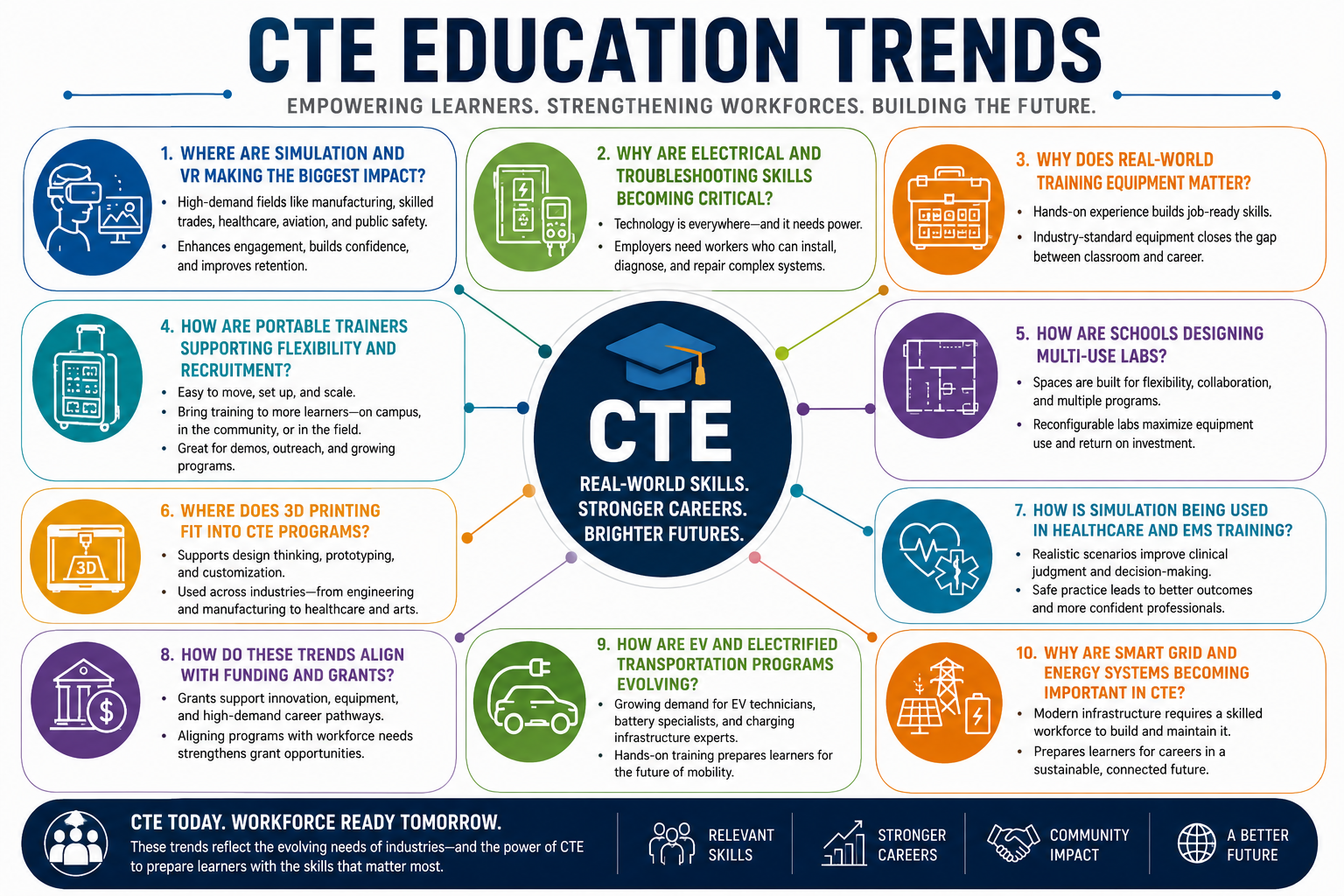
Career and Technical Education (CTE) programs are evolving quickly. As workforce demands shift and industries adopt new technologies, schools are rethinking how they prepare students for real careers.
Quick Answer: The biggest trends in CTE right now include simulation and VR, stronger electrical and troubleshooting skills, flexible lab environments, and training systems that mirror real-world applications—all aligned to workforce needs and funding priorities.
In this Blog
- Where are simulation and VR making the biggest impact?
- Why are electrical and troubleshooting skills becoming critical?
- Why does real-world training equipment matter?
- How are portable trainers supporting flexibility and recruitment?
- How are schools designing multi-use labs?
- Where does 3D printing fit into CTE programs?
- How is simulation being used in healthcare and EMS training?
- How do these trends align with funding and grants?
- How are EV and electrified transportation programs evolving?
- Why are smart grid and energy systems becoming important in CTE?
Key Takeaways
- Simulation and VR are expanding access to hands-on training while reducing consumable costs
- Electrical, troubleshooting, and systems thinking skills are becoming critical across all programs
- Full-scale training systems are improving real-world readiness and employer alignment
- Portable trainers are enabling flexible instruction, program expansion, and student recruitment
- Multi-use labs are maximizing equipment utilization and supporting interdisciplinary learning
- 3D printing is driving innovation and connecting design-to-manufacturing workflows
- Medical and healthcare simulation is improving outcomes while increasing training efficiency
- Electrification is expanding training needs across EV infrastructure, battery manufacturing, and energy systems
- Smart grid and power systems training are connecting electrical, HVAC, and industrial programs
- Funding and grants are increasingly aligned with workforce-driven, technology-enabled training environments
1. Simulation and VR Are Expanding Access to Training
Simulation and virtual reality (VR) are rapidly becoming foundational tools in CTE programs—not just as enhancements, but as core components of modern training strategies. As programs face increasing pressure to provide hands-on experience with limited budgets, space, and instructor time, simulation offers a scalable way to expand access without compromising quality.
What makes simulation especially valuable is its ability to bridge the gap between introduction and application. Students can experience real-world scenarios earlier in their learning journey, build confidence through repetition, and transition more effectively into hands-on environments.
- Career exploration (middle school + early high school) – exposing students earlier and supporting recruitment into pathways
- Healthcare and EMS training – patient care, emergency response, and clinical simulations
- Skilled trades and equipment training – safe environments for high-risk or high-cost systems
Another key advantage is cost efficiency. Simulation reduces reliance on consumables such as medical supplies, raw materials, and fuel, allowing programs to increase training frequency while controlling expenses.
2. Stronger Focus on Electrical, Troubleshooting, and Systems Thinking
One of the biggest shifts impacting CTE programs is the move toward electrified, digitally controlled systems. Across industries, mechanical systems are being replaced or enhanced by electrical components, automation, and smart controls.
This shift is creating a clear skills gap—especially in areas like HVAC—where students often struggle more with electrical concepts than mechanical ones.
(See: Why HVAC Students Struggle with Electrical—and How Training Programs Can Close the Gap)
- Electrical fundamentals introduced earlier in programs
- Fault insertion training (Amatrol FaultPro-style systems)
- Troubleshooting-based learning vs. step-by-step tasks
- Integration across HVAC, electrical, and automation systems
Programs are shifting from teaching “how to do” toward teaching students how to diagnose, think, and adapt—a critical skill in modern technical careers.
3. Full-Scale Training Systems That Mirror the Real World
Employers expect students to be familiar with real systems—not just concepts. As a result, CTE programs are investing in full-scale training systems that replicate actual workplace environments.
These systems allow students to interact with real components, controls, and processes, helping them better understand how systems function as a whole.
- HVAC systems with integrated electrical controls
- Industrial automation and robotics systems
- Electrical trainers with real diagnostics and measurement tools
This level of realism improves student confidence, reduces onboarding time for employers, and leads to stronger workforce outcomes.
4. Portable Training Systems Are Driving Flexibility and Recruitment
Portable training systems are transforming how programs deliver hands-on learning. Instead of being limited to a single lab space, instructors can bring training directly to students—wherever they are.
These systems are also becoming powerful recruitment tools, allowing schools to demonstrate hands-on experiences at events, middle schools, and community outreach programs.
- Flexible instruction across classrooms and campuses
- Shared equipment across multiple programs
- Hands-on demonstrations for recruitment and outreach
- Scalable program growth without expanding facilities
For many schools, portable systems are supporting both instruction and enrollment growth.
5. Multi-Use Labs Are Maximizing Investment
With increasing pressure on budgets, schools are moving away from single-purpose labs and toward flexible environments that support multiple programs.
These labs allow equipment to be shared across disciplines, increasing utilization and supporting interdisciplinary learning.
- Electrical, HVAC, and industrial maintenance integration
- Automation and robotics used across programs
- Shared core systems for multiple courses
This approach improves return on investment and strengthens justification for funding and grants.
6. 3D Printing and Advanced Manufacturing Are Expanding
Additive manufacturing is becoming a core part of modern CTE programs, especially in engineering, manufacturing, and STEM pathways.
It introduces students to digital workflows while supporting innovation and problem-solving.
- Design-to-production workflows
- Rapid prototyping
- Cross-program applications
3D printing also serves as an accessible entry point into advanced manufacturing technologies.
7. Medical and Healthcare Simulation Is Growing Rapidly
Healthcare programs are expanding quickly, and simulation is essential for preparing students for real-world patient care.
Because of the high-risk nature of healthcare, students must build skills and confidence before working in clinical environments.
- Patient simulators for clinical training
- Emergency and trauma scenarios (EMS)
- Repeatable and standardized training experiences
Simulation improves outcomes while reducing consumable costs and increasing practice opportunities.
8. Funding and Grants Are Driving Program Decisions
Many of these trends align directly with funding priorities at the state and federal level. Programs that demonstrate workforce alignment and hands-on learning are often better positioned to secure funding.
Grants increasingly support:
- Industry-relevant training systems
- Technology integration (VR, simulation, advanced manufacturing)
- Scalable and flexible lab environments
- Programs tied to high-demand careers
Schools that align their programs with these priorities can strengthen both funding opportunities and long-term program sustainability.
9. Electrified Transportation, Charging Infrastructure, and Battery Manufacturing Are Expanding
Electric vehicles are often the most visible example of electrification, but their impact on CTE programs extends far beyond automotive service. EV technology is part of a much larger ecosystem that includes charging infrastructure, battery manufacturing, power systems, and advanced automation.
As industries shift toward electrified systems, training programs are expanding to reflect the full lifecycle—from energy generation and storage to vehicle operation and infrastructure support.
This means EV-related training is no longer confined to automotive programs. It is increasingly being integrated into electrical, manufacturing, and engineering pathways.
- EV charging infrastructure – installation, testing, and maintenance of residential, commercial, and public charging stations
- Battery systems and manufacturing – safety protocols, cell assembly, quality control, and diagnostics
- High-voltage electrical systems – power electronics, inverters, converters, and system protection
- Automation and smart manufacturing – robotics, PLCs, and data-driven production environments used in battery and EV manufacturing
Battery manufacturing, in particular, is driving demand for new skill sets that combine electrical knowledge, precision manufacturing, and advanced safety standards. These environments often require tighter tolerances, increased automation, and integrated data systems—making them highly interdisciplinary.
Programs that incorporate EV infrastructure and battery manufacturing concepts are better preparing students for a wide range of careers—not just in transportation, but in energy, manufacturing, and industrial systems.
For many schools, this area also presents strong opportunities for funding and industry partnerships, as electrification continues to be a major focus for workforce development initiatives.
10. Smart Grid, Energy Systems, and Power Infrastructure Training Are Gaining Focus
As electrification expands, so does the need to understand how power is generated, distributed, and managed. Modern infrastructure is evolving into interconnected energy systems that require new skills in grid management, energy storage, and digital monitoring.
CTE programs are beginning to incorporate smart grid and power systems training to prepare students for careers in utilities, energy, advanced manufacturing, and infrastructure.
- Power generation, transmission, and distribution systems
- Renewable energy integration (solar, wind, storage)
- Grid monitoring, data systems, and control technologies
- Energy efficiency and building systems (including electrified HVAC)
These systems connect directly to other program areas—automation, electrical, HVAC, and industrial maintenance—making them ideal for multi-use labs and interdisciplinary training environments.
As industries place greater emphasis on energy efficiency, sustainability, and grid reliability, programs that incorporate smart grid concepts are better positioned to align with both workforce demand and funding opportunities.
CTE programs that align with these trends are better positioned to improve outcomes, attract students, and secure funding.