Modernizing Welding Training Equipment in Schools with Modular Robotic Systems
Affordable Welding Lab Upgrades for Schools and Colleges

Modernizing welding training equipment in schools is no longer optional—it’s essential for preparing students for today’s automated manufacturing environments. However, many Career and Technical Education (CTE) programs face real challenges when upgrading their labs, including budget constraints, safety concerns, and instructor readiness.
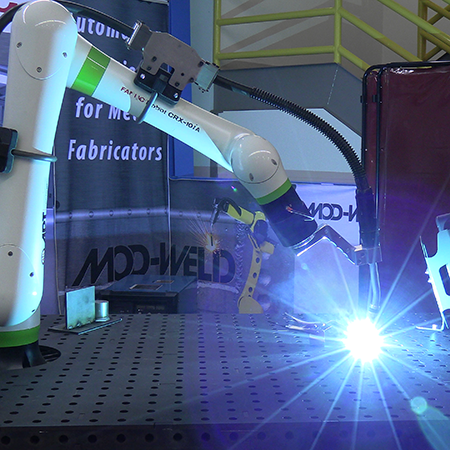
Modular robotic systems like Mod-Weld® offer a practical solution by delivering industry-relevant training in a flexible, classroom-ready format.
In this Blog
- Why Welding Labs Need Modernization
- Barriers to Upgrading Welding Training Equipment
- What Is Modular Robotic Welding Training?
- How Mod-Weld® Supports Vocational Welding Program Modernization
- Funding Options for Welding Training Equipment Upgrades
- Frequently Asked Questions
Why Welding Labs Need Modernization
Today’s welding careers increasingly involve automation, robotics, and advanced manufacturing systems. Employers expect graduates to understand not only manual welding techniques but also robotic welding processes, programming, and system integration.
Without updated equipment, students may graduate lacking the skills needed to succeed in modern welding environments.
- Robotic welding is widely used in manufacturing
- Industry demand for automation skills continues to grow
- Students need exposure to both manual and automated systems
Barriers to Upgrading Welding Training Equipment
Many institutions recognize the need for welding training equipment upgrades, but several barriers often delay progress. The good news is that those barriers are often more manageable than they first appear—especially when schools consider modular, education-focused solutions rather than assuming they need to invest in a full industrial robotic cell from day one.
One of the biggest concerns for schools is cost. Traditional robotic welding systems can carry a high upfront price tag, especially when institutions factor in the robot, welding package, safety guarding, installation, lab modifications, and instructor training. For many secondary and postsecondary programs, that kind of investment can delay modernization for years.
At the same time, doing nothing also has a cost. Outdated labs can make it harder to recruit students, align with industry expectations, and demonstrate that a program is preparing learners for today’s manufacturing environments.
Modular systems help address this challenge by giving schools a more accessible entry point. Instead of requiring a large, all-at-once purchase, modular robotic welding trainers can support phased implementation, allowing programs to modernize strategically while building a stronger case for future expansion.
Safety is another major factor in vocational welding program modernization. Full-scale industrial robotic welding systems may require dedicated floor space, guarding, ventilation planning, and stricter operating procedures. For schools, this can raise understandable concerns about how to introduce automation without creating unnecessary risk or complexity.
In many cases, administrators and instructors are not opposed to robotic welding—they simply want a solution that fits a teaching environment. They need equipment that supports safe demonstrations, manageable student interaction, and clear instructional structure.
Education-focused modular systems are designed with those concerns in mind. They offer a more controlled way to introduce robotic welding concepts, helping students build familiarity with automated processes while supporting safer classroom use and more gradual program adoption.
Even when funding is available, instructor confidence can be a deciding factor. Many welding instructors are highly experienced in manual processes and fabrication, but may not have had the opportunity to train on robotic welding systems themselves. That does not mean they are resistant to change—it means they need technology that feels teachable, approachable, and relevant.
This is one of the most overlooked barriers to adopting new welding technology. If the equipment feels too complex, too industrial, or too disconnected from the rest of the program, adoption can stall. Instructors may worry about losing valuable class time, troubleshooting unfamiliar systems, or being expected to teach advanced content without enough support.
Modular robotic welding training can help bridge that gap by introducing concepts step by step. Instead of forcing instructors to overhaul their curriculum overnight, modular systems can support a smoother transition into automation topics while still reinforcing core welding knowledge and hands-on instruction.
Physical space is a practical issue in many welding labs. Programs may already be operating in crowded shops that need to accommodate booths, work tables, fume extraction, material storage, and traffic flow for multiple students at once. Adding a large industrial robotic cell is not always realistic.
This is where modularity matters. Compact training solutions can make it easier for schools to introduce new technology without redesigning the entire lab. That flexibility is especially valuable for community colleges, technical centers, and high school programs that want to expand their offerings but do not have the square footage for a major equipment footprint.
When schools can integrate robotic welding training into their existing environment, modernization becomes more practical. Instead of waiting for a new building or major renovation, programs can begin introducing advanced skills sooner.
What Is Modular Robotic Welding Training?
Modular systems break down complex robotic welding processes into manageable, hands-on learning experiences. These systems are designed specifically for education, allowing students to learn step-by-step without the complexity of full-scale industrial setups.
- Portable and compact design
- Scalable training modules
- Safe for classroom environments
- Aligned with industry practices
How Mod-Weld® Supports Vocational Welding Program Modernization
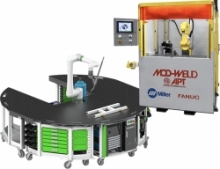
Mod-Weld® is a modular robotic welding training solution designed to help schools modernize their programs without overwhelming budgets or instructors.
It introduces students to robotic welding concepts while maintaining a strong foundation in traditional welding skills.
- Teaches robotic welding fundamentals and programming
- Supports hands-on, competency-based learning
- Designed for classroom safety and ease of use
- Helps instructors transition into advanced training topics
Funding Options for Welding Training Equipment Upgrades
Schools looking to modernize welding labs can often leverage multiple funding sources to support technical education funding initiatives.
- Perkins V funding
- State workforce development grants
- Industry partnerships
- Local and regional economic development programs
Modular systems can make funding requests more attainable by reducing upfront costs and allowing phased implementation.
Key Takeaways
- Modernizing welding training equipment in schools is critical for workforce readiness
- Budget, safety, and instructor adoption are common barriers
- Modular robotic systems offer a practical, scalable solution
- Funding options are available to support welding lab upgrades
Frequently Asked Questions
One of the most effective ways to modernize welding training equipment in schools is to start with scalable, classroom-ready systems that align with current industry practices. For many programs, that means introducing robotic welding concepts through modular training solutions rather than jumping immediately into a full industrial setup.
This approach helps schools balance workforce relevance with practical realities like budget, space, and instructor readiness. It also allows programs to build momentum over time, adding capabilities as funding and confidence grow.
The cost to upgrade a welding lab can vary significantly depending on the size of the program, the type of equipment being added, and whether the school needs changes to layout, power, ventilation, or safety infrastructure. A full industrial robotic welding setup is typically much more expensive than a modular education-focused trainer.
That is why many schools begin with phased upgrades. Starting with modular equipment can reduce the initial investment while still helping students gain exposure to robotic welding, automation, and modern manufacturing workflows.
Schools may be able to support welding training equipment upgrades through Perkins V, state and regional workforce development grants, employer partnerships, foundation support, and other technical education funding sources. In some cases, local industry partners may also help justify or support investments when they see a direct connection to workforce needs.
Modular solutions can strengthen a funding request by offering a more manageable entry point. They help programs demonstrate that modernization can happen in practical stages rather than requiring a single large purchase.
Robotic welding is important because it reflects the way many manufacturers operate today. Students entering welding, fabrication, and advanced manufacturing careers may be expected to work alongside automated systems, understand programming basics, and troubleshoot processes in technology-rich environments.
Exposure to robotic welding does not replace foundational welding skills. Instead, it expands student readiness by helping them understand how manual skills connect to automation, productivity, quality, and modern manufacturing practices.
The biggest barriers often include budget limitations, safety concerns, instructor confidence, and available lab space. Schools may also worry about whether the technology will be too advanced for their students or too difficult to integrate into their existing curriculum.
These concerns are valid, but they can often be addressed with education-focused systems designed for step-by-step implementation. When the technology is modular, approachable, and built for training environments, adoption becomes much more realistic.
Modular robotic welding training helps instructors by making advanced technology easier to teach. Instead of requiring them to master an entire industrial system at once, modular platforms can introduce core concepts in a more structured, manageable way.
This supports instructor adoption, reduces intimidation around new technology, and makes it easier to connect robotic welding concepts back to the manual welding foundations students are already learning.
Ready to Modernize Your Welding Lab?
Whether you're starting small or planning a full upgrade, modular solutions like Mod-Weld® can help you move forward with confidence.
Contact Tech-Labs today to explore welding training equipment upgrades tailored to your program.