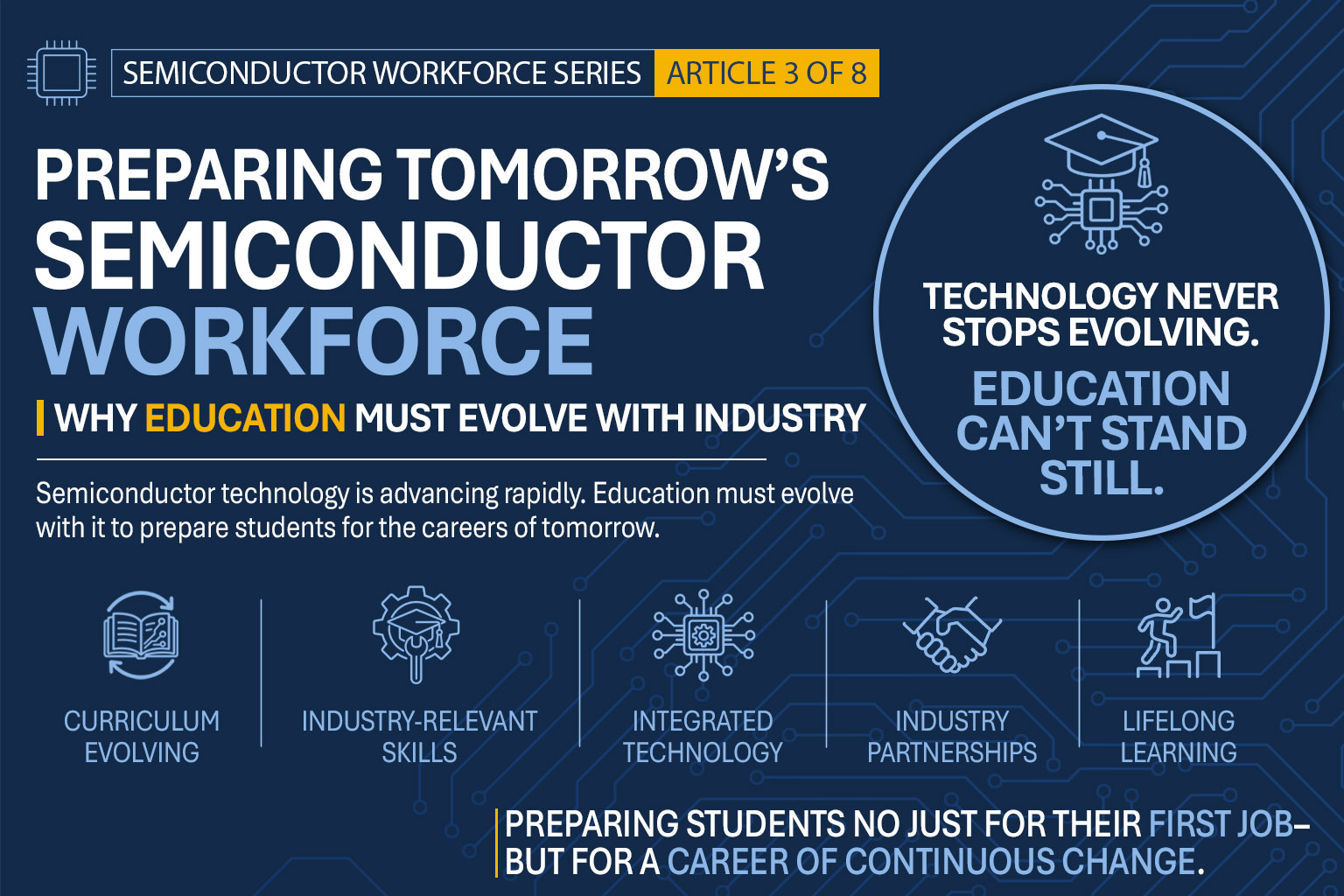
Preparing Tomorrow’s Semiconductor Workforce
Why Education Must Evolve with Industry | Article 3 of 8
Executive Summary
Building a stronger semiconductor workforce requires more than inspiring students to pursue technical careers. Educational institutions must also prepare those students for an industry evolving at an unprecedented pace. As semiconductor manufacturing becomes increasingly sophisticated, successful workforce programs must continuously adapt their curriculum, technologies, instructional methods, and industry relationships to ensure graduates are prepared for the challenges waiting beyond the classroom.
Table of Contents
- Why Must Semiconductor Education Continue to Evolve?
- Why Technical Education Must Keep Evolving
- What Does Industry Expect from Today’s Graduates?
- How Education and Industry Build Workforce Readiness Together
- How X-Cal Helps Educators Stay Current
- Conclusion
- One Final Thought
- Frequently Asked Questions
- Coming Next in the Semiconductor Workforce Development Series
Why Must Semiconductor Education Continue to Evolve?
Somewhere this morning, an instructor is preparing to teach tomorrow’s semiconductor workforce.
The lesson plan has been carefully developed, the classroom is ready, and students are eager to learn. Yet before the first lecture begins, the industry they are preparing to enter has already taken another step forward. Equipment, manufacturing processes, automation, and software continue to advance at a pace few industries have experienced.
That reality defines one of the greatest challenges facing semiconductor workforce development today.
Preparing students for semiconductor careers has never been more important or more demanding. The knowledge they need is not static; it changes alongside the equipment, processes, and manufacturing environments they will eventually support.
For educators, success is no longer measured only by program completion or credentials. It is also measured by whether graduates possess the technical foundation, adaptability, and problem-solving ability needed in a profession built around continuous learning.
That shift changes how technical programs must be designed and evaluated. Proven instructional methods still matter, but curriculum, laboratories, and instructor development must be reviewed more frequently and informed by current industry practice.
Key Takeaway
Preparing tomorrow’s semiconductor workforce requires educational programs that evolve as rapidly as the industry they serve.
What Modern Semiconductor Programs Must Teach
Traditional technical education has helped prepare generations of skilled manufacturing professionals, and its contributions should not be overlooked. Strong instructional foundations, experienced educators, and proven teaching methods remain essential components of successful workforce development.
What has changed is the environment those graduates enter.
Modern semiconductor facilities bear little resemblance to the manufacturing environments many educators encountered early in their careers. Today’s fabs combine precision automation, robotics, vacuum technology, process instrumentation, gas-delivery systems, metrology, advanced process control, data analytics, and artificial intelligence. Employees must understand how those systems interact while maintaining the contamination control, safety, and quality standards required in a cleanroom environment.
As the workplace evolves, education must evolve with it.
That does not mean abandoning proven teaching principles. It means applying those principles within learning environments that more closely reflect today’s industrial reality.
Students still need strong foundations in electronics, electrical systems, instrumentation, automation, safety, and quality. They must also understand how those disciplines connect inside an integrated semiconductor facility—from sensors and vacuum systems to robotics, process data, contamination control, and human decision-making.
The goal is to prepare students for the environment they will encounter on their first day of work—and for the one they will encounter five years later.
That distinction changes curriculum development. Rather than asking only when a program was last updated, educators must ask whether its content, equipment, and learning experiences still reflect current industry practice.
Curriculum must keep pace not only with textbooks, but with technology itself.
Today’s educators do far more than deliver information. They help students develop the curiosity, confidence, and adaptability required for a career in which learning never truly ends.
The strongest programs continually evaluate what they teach, how they teach it, and whether those experiences reflect the expectations of today’s semiconductor industry.
Industry Insight
The most effective semiconductor education programs don’t simply teach students what the industry knows today. They prepare students to keep learning as the industry evolves tomorrow.
What Does Industry Expect from Today’s Graduates?
Every employer hopes to hire graduates who possess strong technical knowledge, a positive attitude, and a willingness to learn. Those qualities have always mattered. What has changed is the complexity of the environments new employees enter on their first day.
Today’s semiconductor manufacturers operate some of the most advanced production facilities in the world. Every process depends on extraordinary precision, consistent quality, and disciplined execution. Equipment operates within extremely narrow tolerances. Manufacturing systems generate enormous amounts of data. Even routine maintenance activities often require technicians to understand how multiple systems interact rather than viewing each component independently.
As a result, employers increasingly seek graduates who can think beyond individual tasks and understand the larger manufacturing process.
Technical knowledge remains essential, but today’s workforce must also demonstrate curiosity, adaptability, analytical thinking, communication, and a commitment to continuous improvement. Semiconductor manufacturing is built upon procedures and standards, yet it also rewards employees who ask thoughtful questions, recognize patterns, and approach problems with a disciplined process rather than assumptions.
One of the defining characteristics of successful semiconductor professionals is their willingness to continue learning long after formal education ends.
Technology, equipment, software, and manufacturing techniques will continue to change throughout a technician’s career.
The most successful professionals understand that graduation is not the conclusion of their education. It is the beginning of a career built on continuous growth.
Educational institutions have an opportunity to help students embrace that mindset long before they enter the workforce. When learners understand that adaptability is one of the industry’s most valuable professional skills, they become better prepared for careers that will continue evolving throughout their working lives.
This perspective also changes how success is measured.
Knowledge remains important, but recall alone is not enough. Educators must also ask whether graduates can follow a disciplined troubleshooting process, interpret data, communicate findings, and adapt as technology advances.
Preparing students for tomorrow’s semiconductor industry means teaching current technologies while developing the habits needed to grow alongside technologies that have not yet been invented.
Workforce Perspective
The semiconductor industry values graduates who combine strong technical foundations with curiosity, adaptability, and a lifelong commitment to learning.
How Education and Industry Build Workforce Readiness Together
Preparing tomorrow’s workforce is not a responsibility education carries alone.
Likewise, manufacturers cannot expect educational institutions to anticipate every technological advancement without meaningful collaboration. The most successful workforce initiatives emerge when education and industry recognize that they share the same objective: preparing students for meaningful careers while ensuring employers have access to highly capable talent.
This partnership benefits everyone involved.
Industry provides valuable insight into emerging technologies, changing workforce needs, and the skills graduates will need to succeed. Educational institutions transform that knowledge into learning experiences that prepare students for long-term careers rather than immediate job openings. Workforce organizations help coordinate regional priorities, while community leaders create opportunities that strengthen local economies through technical education.
Each partner contributes something different.
Together, they create workforce readiness.
No single organization can remain current in isolation. Manufacturers identify changing skill requirements, educators refine instructional methods, workforce organizations monitor regional needs, equipment providers introduce new technologies, and professional associations develop standards and certifications.
When these groups communicate regularly, educational programs become more responsive to industry while maintaining the academic rigor students deserve.
Students ultimately benefit the most.
Instead of graduating into unfamiliar environments, they enter workplaces that reflect concepts, technologies, and expectations they have already begun to understand during their education. The transition from school to employment becomes smoother because education and industry have worked together rather than independently.
Perhaps more importantly, these relationships build confidence.
Students gain confidence that their education is relevant, educators know their programs reflect current needs, and employers have greater confidence that graduates are prepared to contribute.
How X-Cal Helps Educators Stay Current
For more than forty-five years, X-Cal has worked alongside educators, manufacturers, workforce organizations, and government agencies to strengthen technical education across the United States. Throughout those partnerships, one lesson has remained remarkably consistent: successful workforce development depends upon continuous improvement.
Our role extends beyond providing educational equipment. We help partners assess workforce needs, identify curriculum and laboratory gaps, plan industry-aligned learning environments, support instructor development, and connect classroom experiences with the systems used in modern semiconductor and advanced manufacturing facilities.
That program-level approach extends beyond semiconductor manufacturing.
Whether the need involves automation, industrial maintenance, robotics, electrical systems, or semiconductor education, the objective remains the same: help educators build programs that are technically rigorous, relevant to employers, and sustainable over time.
Meaningful workforce development is built over time through industry input, thoughtful planning, regular program evaluation, and a willingness to adapt.
Conclusion
Preparing tomorrow’s semiconductor workforce requires more than expanding enrollment or modernizing curriculum. It requires educational programs that evolve with the industries they serve and graduates who embrace continuous learning throughout their careers.
The semiconductor industry will continue advancing at an extraordinary pace. Manufacturing technologies will become more sophisticated. Automation will become increasingly intelligent. New challenges and new opportunities will emerge that few people can fully predict today.
Educational institutions cannot prepare students for every future innovation.
They can, however, prepare students to think critically, adapt confidently, continue learning, and build successful careers regardless of how technology evolves.
Those qualities will remain valuable no matter what tomorrow brings.
One Final Thought
Every generation prepares the workforce that will inherit technologies still being imagined.
The greatest responsibility of today’s educators is not simply teaching students what the semiconductor industry looks like today. It is helping them develop the curiosity, adaptability, and confidence to help shape what the industry becomes tomorrow.
Frequently Asked Questions
Semiconductor manufacturing changes rapidly as new technologies, automation systems, manufacturing processes, and equipment are introduced. Educational programs must evolve alongside industry to ensure graduates possess relevant knowledge and remain prepared for long-term career success.
Semiconductor manufacturing combines multiple engineering and technical disciplines within highly integrated production environments. Successful programs prepare students to understand how these technologies work together while developing the adaptability needed for continuous technological change.
Technology evolves throughout a technician’s career. Professionals who embrace lifelong learning remain better prepared to adapt to new equipment, manufacturing processes, software platforms, and emerging technologies.
Successful programs continually evaluate curriculum, collaborate with industry, support instructor development, modernize learning environments, and focus on preparing students for long-term careers rather than only their first job.
X-Cal partners with educators, manufacturers, workforce organizations, and government agencies to strengthen workforce development through industry-aligned learning environments, professional development, curriculum support, and educational technologies that help prepare students for advanced manufacturing careers.
Coming Next in the Semiconductor Workforce Development Series
Article 4: From Classroom to Cleanroom
Why Hands-On Learning Builds Workforce Readiness
Modern semiconductor manufacturing cannot be mastered through textbooks alone. In the next article, we’ll explore why hands-on learning has become one of the most important elements of semiconductor workforce development, how experiential education builds confidence alongside technical competence, and why authentic learning environments help bridge the gap between the classroom and the cleanroom.
About the Author

Chris Harris brings a unique perspective as President at Tech-Labs and X-Cal, a mindset and performance expert, and a former elite trainer for military special forces. With a 25-year background in high-performance leadership, Harris has authored 14 books—including Bridging America’s Skills Gap, co-authored with Mark Goodman—and inspired audiences in over 60 countries.