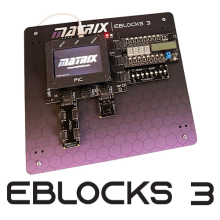
Flexible microcontroller training with EBlocks 3 from Matrix TSL. Teach Arduino, PIC, and ESP systems with Flowcode integration, Auto ID, and hands-on learning.
Introduction to Microcontrollers
CP4807
Introduction to Microcontrollers is a beginner-friendly curriculum designed to help students build confidence in programming microcontrollers for the first time. Using a structured sequence of guided activities, learners move from simple hardware control tasks to more advanced programming concepts, creating a strong foundation for future study in electronics, automation, and embedded systems.
The core curriculum includes 25 worksheets supported by instructional video content, allowing students to progress through each topic with both written guidance and visual reinforcement. Beginning with basic tasks like flashing an LED, students gradually develop the skills needed to work with interrupts, displays, inputs, outputs, and core programming logic in a hands-on learning environment.
This introductory curriculum is designed to make microcontroller programming approachable and engaging for first-time learners. With approximately 15 hours of learning content, it provides a clear pathway through essential concepts while encouraging experimentation and problem-solving.
- 25 guided worksheets covering foundational to intermediate topics
- More than 20 instructional videos to support learning
- Progression from basic LED control to timer and pin interrupts
- Designed for hands-on electronics and microcontroller education
- Accompanying example files available on the Flowcode Wiki
Students learn to program microcontrollers using Flowcode, a flowchart-based development environment that simplifies the learning process. By focusing on logical program structure instead of syntax-heavy coding, learners can better understand how microcontrollers process instructions and interact with hardware.
This approach is especially effective for education because it allows students to quickly visualize cause and effect while building confidence in programming concepts that can later transfer to text-based languages.
Learners gain practical experience working with common hardware components used in microcontroller systems, helping them understand how software controls real devices.
- LEDs
- Switches
- LCD displays
- Graphical displays
- 7-segment displays
The curriculum introduces a wide range of programming concepts that support both foundational learning and skill progression into more advanced embedded applications.
- Inputs and outputs
- Delays and timing control
- Decision structures, including IF and CASE
- Connection points
- Variables, data types, and strings
- Loops and iterative logic
- Hardware macro functions
- Software macro functions
- Calculations and logic operations
- Comments and program documentation
- Timer interrupts
- Pin interrupts
- Analog-to-digital and digital-to-analog functions
- Binary and hexadecimal concepts
In addition to the worksheet-based curriculum, students and instructors benefit from a variety of supporting resources that reinforce understanding and make implementation easier in the classroom or lab.
- More than 20 instructional videos
- Example files hosted on the Flowcode Wiki
- Step-by-step progression for beginner learners
- Flexible use in instructor-led or self-paced environments
This microcontroller curriculum is well suited for programs introducing students to electronics, embedded systems, automation, and engineering technology. It provides a practical first step into programming physical devices while supporting the development of problem-solving, logic, and technical troubleshooting skills.
Whether used in secondary education, technical training, or introductory college-level courses, it offers an accessible way to begin building real-world programming capability.