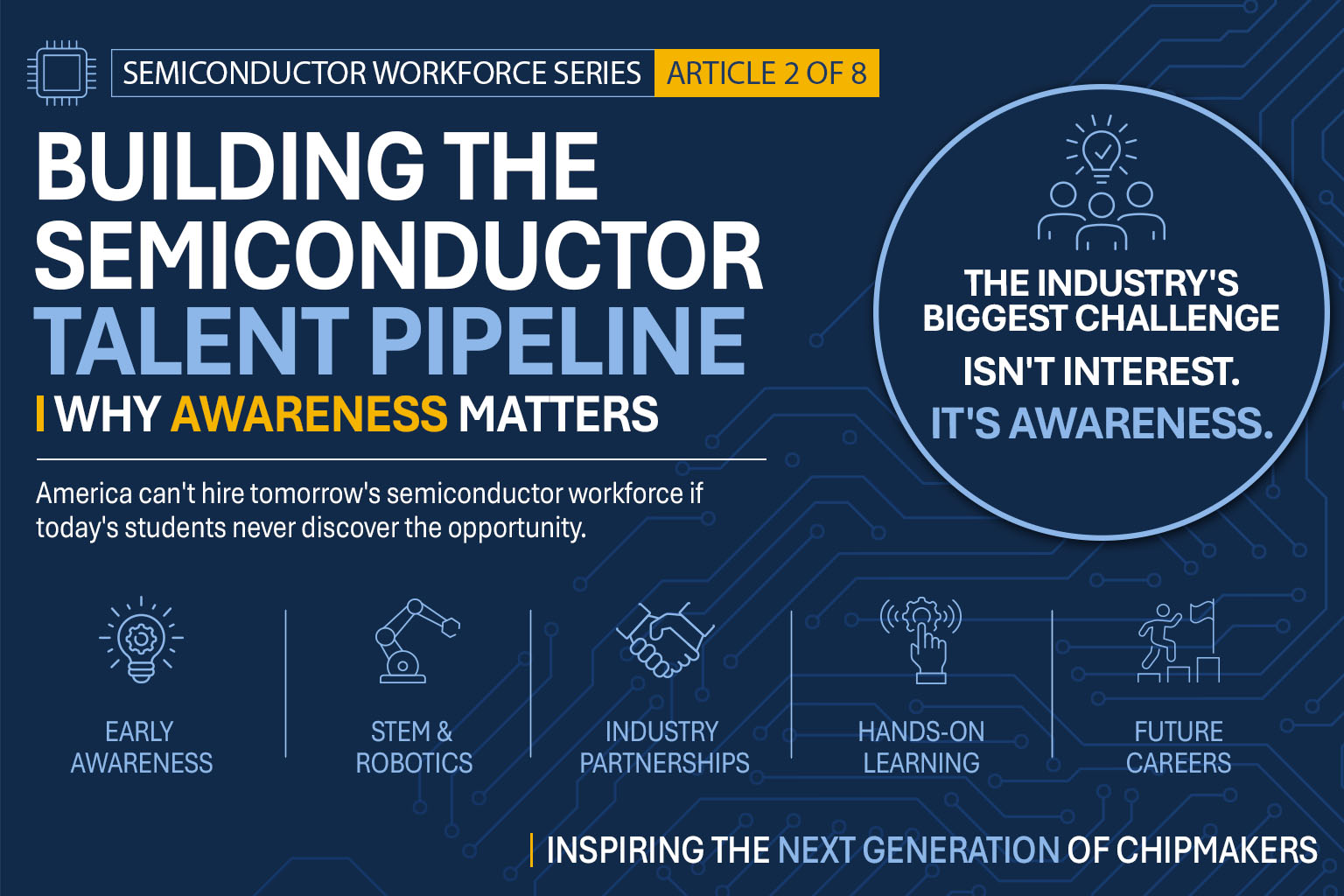
Building the Semiconductor Talent Pipeline
Inspiring the Next Generation of Chipmakers
Executive Summary
America’s semiconductor industry cannot grow without a stronger pipeline of future talent. While manufacturers continue to expand capacity and invest in advanced technologies, too many students remain unaware that this exciting, high-tech industry even exists. Building tomorrow’s workforce begins long before a student submits a job application. It begins by creating awareness, inspiring curiosity, and connecting education with meaningful career opportunities.
Table of Contents
- Why Aren’t More Students Choosing Semiconductor Careers?
- The Awareness Gap Is the Talent Gap
- Why Career Exploration Must Begin Earlier
- How X-Cal Is Helping Build the Talent Pipeline
- Conclusion
- Frequently Asked Questions
- Coming Next in the Semiconductor Workforce Development Series
Why Aren’t More Students Choosing Semiconductor Careers?
Somewhere in America today, a high school sophomore is deciding which classes to take next year. Across town, a community college student is wondering whether engineering technology is the right major, while a military veteran is considering what career to pursue after leaving active service. Each of them possesses the potential to become an outstanding semiconductor technician, automation specialist, maintenance professional, or process engineer. The problem is that most of them have never seriously considered those careers because no one has shown them the opportunity.
That reality sits quietly beneath nearly every workforce discussion taking place across the semiconductor industry. Manufacturers frequently talk about recruiting challenges, educators discuss enrollment, and policymakers focus on strengthening America’s competitiveness in manufacturing. Those conversations are important, but they often begin too late. Before organizations can recruit qualified employees, educational institutions can graduate skilled technicians, or employers can fill critical positions, someone has to inspire a student to begin the journey.
Students cannot pursue careers they have never discovered.
For decades, industries have assumed that good career opportunities naturally attract talented people. While that may have been true in the past, today’s students are surrounded by more career choices, more information, and more distractions than any previous generation. They hear about careers in medicine, law, finance, software development, professional sports, and social media almost every day. Semiconductor manufacturing, despite powering nearly every modern technology, rarely enters the conversation.
That lack of awareness should concern everyone involved in workforce development. Semiconductors power smartphones, automobiles, medical equipment, aerospace systems, artificial intelligence, telecommunications, consumer electronics, and countless other technologies that shape daily life. Yet many students graduate from high school without ever learning how those technologies are manufactured or the remarkable careers available inside one of the world’s most advanced industries.
The challenge is not that students lack curiosity. Young people are naturally drawn toward innovation, technology, and solving meaningful problems. They enjoy building things, experimenting with robotics, programming automation systems, competing in engineering competitions, and exploring emerging technologies. The challenge is helping them recognize that those interests can lead to rewarding careers in an industry that continues to transform the world.
Unfortunately, outdated perceptions often stand in the way. When many parents, counselors, and even educators hear the word manufacturing, they picture assembly lines, repetitive work, and industrial environments that bear little resemblance to today’s semiconductor facilities. Those perceptions may have reflected manufacturing decades ago, but they no longer reflect the reality students would encounter inside a modern fabrication facility.
Today’s semiconductor manufacturing environments are among the most technologically sophisticated workplaces anywhere in the world. Employees work with advanced robotics, automation systems, artificial intelligence, precision instrumentation, cleanroom technologies, data analytics, and highly integrated manufacturing processes that require continuous learning and technical problem-solving. These careers offer intellectual challenge, competitive compensation, long-term growth, and the opportunity to contribute to innovations that improve lives around the globe.
Changing public perception begins with changing the conversation. Instead of introducing semiconductor careers only after students begin searching for jobs, communities should begin introducing them while students are still discovering what excites them. Middle school and high school represent critical years when interests become aspirations, and those aspirations begin to shape educational decisions that influence future career opportunities.
The Awareness Gap Is the Talent Gap
Every successful workforce pipeline begins with awareness. Before students develop technical skills, they must first understand that a career exists, believe it is attainable, and see how their interests connect to the opportunities it offers. When that awareness is missing, the talent pipeline begins narrowing long before employers ever post an opening.
Manufacturers understand the technical skills they need, but many struggle to connect with students early enough to influence career decisions. Educators work tirelessly to prepare students for the future, yet many schools have limited opportunities to expose learners to advanced manufacturing careers or build relationships with local industry. The result is not a shortage of capable students. It is a shortage of meaningful connections between education and the careers waiting beyond the classroom.
This is one of the reasons X-Cal has always believed workforce development extends far beyond equipment or curriculum. Over more than 45 years of partnering with manufacturers, K-12 schools, career and technical education programs, community colleges, universities, and workforce organizations, we have seen firsthand what happens when students experience modern technology rather than simply reading about it. A classroom demonstration becomes a spark of curiosity. A hands-on laboratory exercise becomes confidence. An industry partnership becomes a career pathway.
Those moments matter because they change the way students see themselves. A young person who never imagined working in advanced manufacturing suddenly begins asking different questions. Instead of wondering whether they belong in a technical career, they begin asking what education they need to get there. That shift in thinking is where every strong talent pipeline truly begins.
Why Career Exploration Must Begin Earlier
By the time many students begin thinking seriously about careers, they have already made educational decisions that influence the opportunities available to them. Course selections made in middle school affect high school pathways. High school experiences influence college and technical education choices. Every year that passes without meaningful career exposure makes it more difficult for students to discover industries they were never introduced to in the first place.
Career awareness should not begin during a senior year job fair. It should begin years earlier through classroom experiences, STEM activities, industry speakers, facility tours, robotics competitions, summer camps, internships, and conversations that help students connect what they are learning today with the careers that will exist tomorrow. When students understand why they are learning algebra, electronics, computer science, or engineering principles, those subjects become more meaningful because they are connected to a future they can actually envision.
Parents, teachers, and school counselors also play a critical role in expanding that vision. Students often look to trusted adults for guidance when making career decisions, yet many adults are unfamiliar with today’s semiconductor industry or the remarkable opportunities it offers. Helping families understand how advanced manufacturing has evolved is just as important as helping students understand it, because informed guidance leads to better career decisions.
Communities benefit when these conversations happen early and often. Students discover rewarding careers without leaving the regions where they grew up, educational institutions strengthen enrollment in technical programs, and manufacturers gain access to a larger pool of motivated future employees. The result is a workforce pipeline that grows stronger because everyone is working toward the same objective instead of solving the problem independently.
How X-Cal Is Helping Build the Talent Pipeline
For more than forty-five years, X-Cal has partnered with educators, manufacturers, workforce organizations, and government agencies to strengthen technical education across the United States. During that time, we’ve learned that the most successful workforce programs don’t begin with equipment purchases or curriculum revisions. They begin by inspiring students to believe they belong in technical careers and by giving educators the tools to turn that inspiration into real capability.
That belief shapes the way we work with our partners. We help schools create learning environments that reflect today’s industrial workplace, support instructors with industry-relevant curriculum and professional development, and connect educational programs with the technologies students will encounter after graduation. Every laboratory, every instructor workshop, and every partnership is designed with one goal in mind: preparing students for careers that are both meaningful and in demand.
We also recognize that no organization can solve the workforce challenge alone. Manufacturers understand the skills they need, educators understand how students learn, workforce organizations understand regional priorities, and community leaders understand local economic needs. X-Cal is proud to help bring those groups together because lasting workforce solutions are built through collaboration, not isolation.
Conclusion
America’s semiconductor future will not be shaped solely by the next fabrication facility to open or the next technological breakthrough to reach the marketplace. It will be shaped by whether today’s students become tomorrow’s technicians, engineers, automation specialists, and manufacturing leaders. Every successful career begins with a moment of discovery, and creating more of those moments is one of the greatest opportunities facing the semiconductor industry today.
Building the talent pipeline requires manufacturers willing to engage with education, educators willing to embrace emerging technologies, communities willing to invest in workforce development, and organizations committed to connecting these efforts. When those partnerships exist, students gain access to life-changing opportunities, employers develop stronger talent pipelines, and communities become more competitive for decades to come.
America has never struggled to inspire innovation. The challenge before us is ensuring that we inspire enough young people to become the innovators who will design, operate, maintain, and improve the technologies that power our future. The earlier we begin that process, the stronger our semiconductor workforce will become.
Every student who discovers a passion for advanced manufacturing represents more than another future employee. They represent a future problem solver, innovator, mentor, and leader whose contributions may shape technologies that improve lives around the world. The strongest semiconductor workforce isn’t built when companies compete for the same talent—it is built when communities work together to create more of it.
Frequently Asked Questions
Many students never learn about the opportunities available in the semiconductor industry. Increasing awareness through career exploration, hands-on learning, and stronger connections between education and industry can dramatically expand the future talent pipeline.
Career awareness should begin in middle school and continue throughout high school. Early exposure helps students make informed decisions about coursework, career and technical education programs, and postsecondary pathways that prepare them for high-demand technical careers.
Manufacturers can support career fairs, classroom presentations, facility tours, internships, advisory committees, and partnerships with local schools. These experiences help students understand what modern manufacturing looks like and the rewarding careers available within the industry.
Hands-on experiences transform curiosity into confidence. When students work with automation systems, robotics, electronics, and other industry-relevant technologies, they gain practical skills while beginning to see themselves succeeding in technical careers.
X-Cal partners with educators, manufacturers, workforce organizations, and government agencies to create industry-aligned learning environments that combine modern technology, curriculum, instructor development, and workforce expertise. Our goal is to help prepare students for meaningful careers while strengthening the long-term workforce needs of America’s advanced manufacturing industries.
Coming Next in the Semiconductor Workforce Development Series
Article 3: Preparing Tomorrow’s Semiconductor Workforce
Why Education Must Evolve with Industry
Creating awareness is only the first step in building a stronger workforce. Once students choose a technical pathway, educational programs must equip them with the knowledge, practical experience, and problem-solving skills that today’s semiconductor manufacturers expect. In our next article, we’ll explore how education is evolving alongside industry—and why the strongest workforce programs are those developed in partnership with the employers they serve.
About the Author

Chris Harris brings a unique perspective as President at Tech-Labs and X-Cal, a mindset and performance expert, and a former elite trainer for military special forces. With a 25-year background in high-performance leadership, Harris has authored 14 books—including Bridging America’s Skills Gap, co-authored with Mark Goodman—and inspired audiences in over 60 countries.