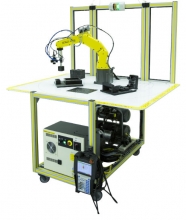
The NEW FANUC LR Mate 200iD/4S Fenceless CERT Cart was developed from combining FANUC DCS Position and Speed Check software with an Allen Bradley SafeZone Mini Safety Laser Scanner. The result is FANUC’s NEW Fenceless Cart that will still fit through a standard door and runs off 110V power. The Fenceless cart allows a greater work envelope and introduces students to the latest in integrated safety products from FANUC and Allen Bradley.
Upper body simulators are cutting-edge educational tools that provide a realistic and detailed representation of the human upper body, encompassing the thorax, arms, and head. These simulators are integral to medical and nursing education, offering hands-on practice in various procedures such as intravenous insertions, chest compressions, airway management, and surgical interventions. By incorporating realistic anatomical features and physiological responses, upper body simulators enable students to develop essential clinical skills in a safe, controlled environment, bridging the gap between theoretical knowledge and real-world application.
A standout feature of upper body simulators is their ability to simulate various medical conditions and scenarios. For example, they can replicate respiratory distress, cardiac events, and trauma injuries, allowing learners to practice critical interventions like intubation, defibrillation, and wound management. This versatility ensures that students are well-prepared for diverse clinical situations they may encounter in their professional careers. The high-fidelity design of these simulators includes lifelike skin, accurate anatomical landmarks, and responsive feedback systems, which help students refine their techniques and decision-making skills with precision and confidence.
Integrating upper body simulators into medical training programs supports a more interactive and immersive learning experience. These simulators facilitate repetitive practice and immediate feedback, which is crucial for mastering complex procedures and improving patient care outcomes. Educational institutions utilizing upper body simulators can offer their students a robust training regimen emphasizing experiential learning, critical thinking, and hands-on proficiency. As technology advances, upper body simulators are becoming increasingly sophisticated, providing even more realistic and effective training opportunities for the next generation of healthcare professionals.
Whole body simulators from TacMed Solutions represent the pinnacle of medical training technology, providing comprehensive, lifelike platforms for practicing a wide range of medical procedures and emergency interventions. These simulators encompass the full anatomical structure of the human body, enabling learners to engage in realistic training scenarios that cover everything from basic first aid to advanced trauma care. Designed with detailed anatomical accuracy, TacMed Solutions' whole body simulators feature realistic skin, internal organs, and physiological responses, allowing trainees to develop and refine their skills in a safe and controlled environment.
One of the key advantages of whole body simulators is their ability to simulate complex, multi-system injuries and medical conditions. Trainees can practice handling scenarios such as polytrauma, cardiac arrest, and respiratory failure, gaining invaluable experience in performing coordinated, life-saving interventions. The simulators' advanced feedback systems provide real-time responses to medical actions, offering immediate, actionable insights that help users improve their techniques and decision-making processes. This immersive training experience enhances technical proficiency and builds the confidence needed to manage critical situations in real-life clinical settings effectively.
Moreover, TacMed Solutions' whole body simulators are designed to support various training environments, from classroom instruction to field exercises. Their durability and versatility make them ideal for use in various educational settings, including medical schools, nursing programs, and emergency response training. By integrating these simulators into their curricula, institutions can offer a more dynamic and interactive learning experience that emphasizes hands-on practice and critical thinking. The commitment to quality and realism in TacMed Solutions' whole body simulators ensures that learners are thoroughly prepared to deliver high-quality care and improve patient outcomes in their professional practice.
Bridging the Gap Between Education and Industry
Tuesday, July 16, 2024
Discover how Mountainland Technical College (MTECH) in Utah is revolutionizing its Automation Technology program with state-of-the-art equipment and a comprehensive curriculum. Join program coordinator Jeff Erickson and instructor Kiele Lee as they share their experiences and the profound impact of using cutting-edge technology in their classrooms.
In this video, you'll learn about:
- The program uses a wide range of equipment, from pneumatics and hydraulics to advanced PLC logic controls and FANUC Robotics and mechatronics.
- The seamless integration of curriculum and hands-on training, made possible by X-CAL and Tech-Labs, ensures students acquire the essential skills needed for industry success.
- The SACA certification program validates student competencies through rigorous testing and prepares them for real-world challenges.
- Inspiring student success stories, including those who have transitioned from different backgrounds and significantly improved their career prospects.
Ready to elevate your school's technical training programs? Contact us today to learn how our training solutions can help your program achieve the same success!
Transform your curriculum and empower your students to thrive in their careers!
EPIC Leads the Way in Industry Training
Tuesday, September 10, 2024
In this video, Cam Wyatt and Triniti Gutierrez share how X-Cal's support transformed an idea into a reality. From providing the latest training equipment to offering technical expertise, X-Cal played a key role in helping EPIC bring hands-on education to life. This trailer allows students to explore real-world trade opportunities, filling critical employment gaps in the construction industry.
At X-Cal, we specialize in helping institutions like EPIC achieve their mission by equipping them with the tools and knowledge needed to succeed. Whether it's mobile learning labs or state-of-the-art training solutions, X-Cal is committed to empowering the next generation of skilled workers. Let us help your organization do the same.
Robotic welding is transforming industries, and education is essential to prepare the next generation of skilled professionals. Our Robotic Welding training solutions are designed to provide students with hands-on experience using advanced robotic systems, equipping them with the skills needed to operate, program, and maintain robotic welding equipment. These programs not only cover the fundamentals of welding processes but also focus on the integration of robotics in manufacturing, helping learners stay ahead of the curve in an increasingly automated world.
Our comprehensive training solutions simulate real-world environments and incorporate the latest industry technologies. By integrating robotic welding into educational programs, students can gain critical certifications and job-ready skills, making them valuable assets to employers in fields like automotive, aerospace, and heavy manufacturing. These training systems ensure students are prepared for the demands of Industry 4.0, where automation and robotics are key drivers of success.
Learn About the SACA and Its Role in Building a Future-Ready Workforce
Monday, September 23, 2024
The Smart Automation Certification Alliance (SACA) webinar, moderated by Gary Tomalin, brings together industry experts to discuss the critical role of certifications in closing the skills gap in smart manufacturing and automation. As a leader in workforce development with over 30 years of experience, Gary guides the conversation with panelists from SACA, Rockwell Automation, and Mountainland Technical College. Together, they explore how SACA is shaping the future of workforce training, with a focus on Industry 4.0 standards, reshoring of manufacturing, and creating a pipeline of skilled technicians.
Panel Overview
In this session, our expert panelists discuss the impact of SACA certifications on the workforce and how these certifications are helping to close the skills gap in smart manufacturing and automation.
- Jim Wall, Executive Director of SACA, highlights the importance of developing certification programs to meet Industry 4.0 standards. Jim’s extensive background in workforce education and certification programs makes him a leader in this space.
- Michael Cook, Director of Industry & Academia at Rockwell Automation, provides insights into how industry and academic institutions are collaborating to create a pipeline of future-ready technicians and engineers. Michael has over 20 years of experience in strategy and business development with a focus on emerging technologies and workforce development.
- Jeff Erickson, Program Coordinator at Mountainland Technical College, brings a boots-on-the-ground perspective. Jeff shares how his automation and robotics programs are using SACA certifications to provide students with the skills needed to meet growing industry demands.
Key Topics Covered
What is SACA?: Jim Wall explains the foundation of SACA, its mission to address the skills gap in Industry 4.0, and how its certifications are becoming a standard in smart manufacturing.
- Global Industrial Certification Pathways: We delve into how SACA is positioned globally and how companies like Amazon and Rockwell Automation are using SACA certifications to upskill their workforce and ensure consistency across locations.
- Industry and Academia Collaboration: Michael Cook speaks on how Rockwell Automation is working with academic institutions to develop curricula that reflect real-world industry needs.
- Certification Levels: Learn about SACA’s Silver and Gold certification pathways. These certifications, offered at no additional cost to students once a school becomes a SACA member, provide an effective way to standardize skills across industries and educational institutions.
Future of Workforce Development
Looking ahead, SACA is developing new certifications in cybersecurity, semiconductors, and electric vehicle production, ensuring that the workforce remains equipped for emerging technologies.
How to Get Involved
If you're interested in learning more about SACA or becoming a member, visit saca.org or reach out via email at support@saca.org.
Revolutionizing Emergency Medical Training with Virtual Reality
Monday, September 23, 2024
Discover how VRNA EMS is transforming emergency medical training through immersive virtual reality technology. This cutting-edge solution allows EMTs and paramedics to practice critical life-saving procedures in highly realistic, customizable scenarios. From patient assessment to trauma response, VRNA EMS delivers a hands-on learning experience that improves decision-making and boosts confidence in real-world situations. Explore the future of EMS training with VRNA and see how virtual reality is bridging the gap between theory and practice. Ready to elevate your training program? Contact us today to learn more!
Emergency Medical Trauma Trainer
Monday, September 23, 2024
The Emergency Medical Trauma Trainer (EMITT) is a versatile collection of mid-fidelity medical trainers designed to meet the specific training needs of civilian first responders. Among its offerings is the EMITT Tactical Medical Upper (TMU), a highly advanced training tool ideal for EMTs, paramedics, and first responders. The TMU features active breathing, intubation capabilities, tension pneumothorax treatment, IV insertion, and more, allowing learners to practice life-saving procedures in diverse environments. Its durable construction includes a urethane core and synthetic skin, providing realism while withstanding harsh conditions.
Key capabilities include airway management, needle decompression, intraosseous infusion, and wound care, all complemented by the ability to receive real-time feedback via a remote control system (sold separately). The trainer’s adjustable eyes simulate various trauma conditions, and its reinforced silicone arms offer full mobility. EMITT’s modular design allows for mixing and matching upper and lower body units to enhance training scenarios, making it a comprehensive tool for tactical medical simulations.
Hands-On Training for Power & Utilities Professionals
Equip your workforce with the essential skills required to thrive in the power and utilities industry through a combination of hands-on, virtual, and e-learning training solutions. Our programs provide learners with practical experience in critical areas like electrical distribution, transformer connections, and safety protocols. With real-world, immersive training, participants will build the confidence needed to handle complex electrical systems, while mastering the core competencies that keep operations safe and efficient.
Whether learners prepare to install, maintain, or troubleshoot modern power systems, our comprehensive training ensures they are ready to meet industry demands. By developing technical expertise in a controlled and engaging environment, we help bridge the growing skills gap and prepare your team for the challenges of tomorrow’s energy infrastructure. Empower your workforce today and ensure long-term success in this essential industry.
Contact us today to discover how our training solutions can help develop your team's technical skills.
Pages
-
-
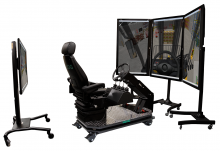 Item Number:FLTSimlog's Forklift Personal Simulator puts trainees at the controls of a typical factory forklift with rear-wheel steering. Challenging training scenarios reproduce the productivity demands of modern factory, warehouse, and distribution center environments. Our intelligent Instructional Design will guide your trainees through a series of 7 skill-building Simulation Modules that emphasize safety in every exercise.
 -
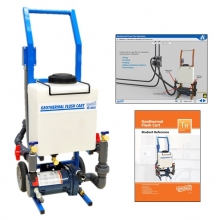 Item Number:95-GEO3Amatrol’s Geothermal Flush Cart Learning System (95-GEO3) teaches how to purge debris and air from the geothermal loop and then charge it with a glycol/water solution
 -
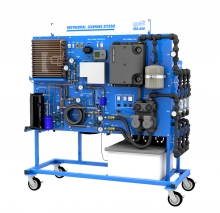 Item Number:950-GEO1Amatrol’s 950-GEO1 Geothermal Energy Training System enables learners to understand and apply their newly obtained technician skills in the ever-growing area of geothermal energy.
 -
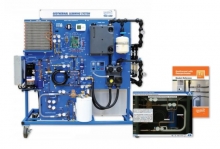 Item Number:950-GEO1DAmatrol’s 950-GEO1 Geothermal Energy Training System enables learners to understand and apply their newly obtained technician skills in the ever-growing area of geothermal energy.
 -
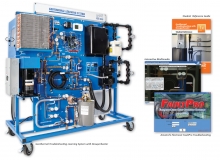 Item Number:950-GEO2DAmatrol’s 950-GEO2D Geothermal Troubleshooting Learning System with Desuperheater uses an exposed component layout so that learners can see each component’s role in a geothermal system.
 -
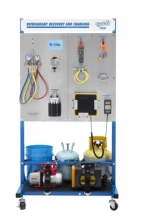 Item Number:T7031With Amatrol’s Refrigerant Recovery and Charging Learning System for R-134a, you can train future HVAC/R technicians hands-on the critical technical skills required for a successful career. Students will work with real equipment, including a recovery machine, manifold gauges, submersible cooler, temperature probe, filter dryer, low side liquid charger, vacuum pump, and micron vacuum gauge.
 -
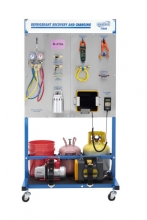 Item Number:T7032Teach aspiring HVAC/R technicians the critical technical skills needed to succeed on the job with Amatrol’s Refrigerant Recovery and Charging Learning System for R-410a (T7032). Students will work with real equipment, including a recovery machine, manifold gauges, submersible cooler, temperature probe, filter dryer, liquid vaporizer, low side liquid charger, vacuum pump, and micron vacuum gauge.
 -
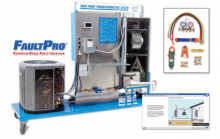 Item Number:T7100Amatrol’s Residential Heat Pump Troubleshooting Learning System (T7100) is used to teach hands-on the critical skills HVAC/R technicians need to succeed when working with residential HVAC systems that use a heat pump and traditional ducting. Students will work with real equipment, including a heat pump condenser, heat pump air handler, Wi-Fi-enabled thermostat, fuse box, ducting, and manifold.
 -
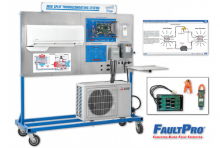 Item Number:T7130With Amatrol’s Residential Mini-Split Heat Pump Learning System (T7130) you can teach the critical hands-on technical skills HVAC/R technicians need when working with residential ductless (“mini-split”) HVAC systems. Students will work with real equipment, including a heat pump condenser, evaporator unit, thermostat, panel-mounted gauges, and condensate pump.