
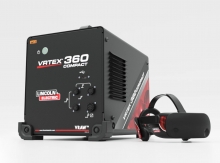
Lincoln Electric's VRTEX® 360 Compact is a small, portable Virtual Reality Welding Simulator for mobile use in multiple environments.
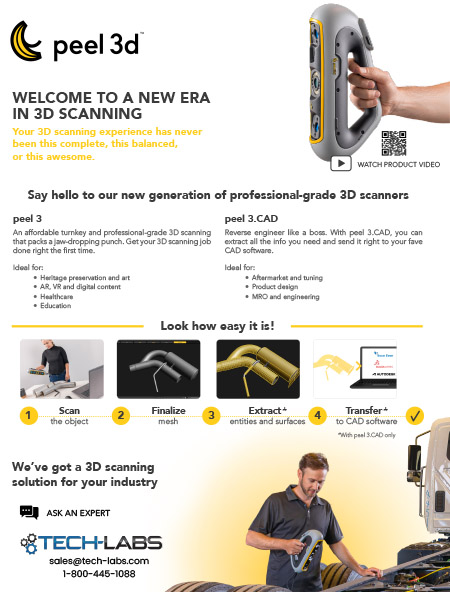
Welcome to a new era in 3D Scanning
peel3 is an affordable turnkey and professional-grade 3D scanning that packs a jaw-dropping punch. Get your 3D scanning job done right the first time.
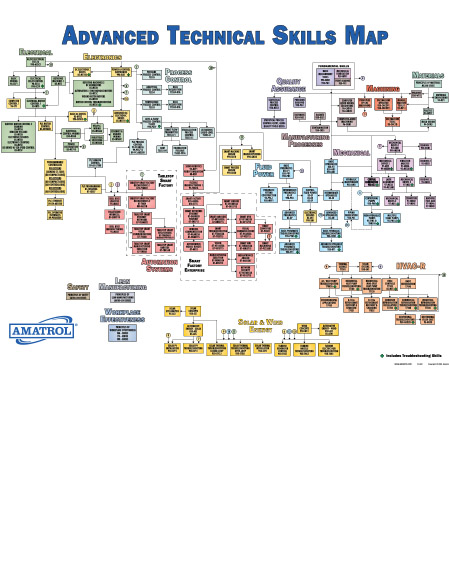
The Advanced Technical Skills Map is a visual guide to Amatrol’s Learning Systems. It provides an overview of available systems and recommendations for course sequence and prerequisites.
Item Number T7017A
Amatrol’s AC/DC Electrical Training System (T7017A) explores the fundamental concepts of AC and DC electrical systems. Learners will see how electricity is used for power and control in industrial, commercial, agricultural, and residential applications. This training system covers industry-relevant technical skills, including operating, installing, designing, and troubleshooting basic AC and DC electrical circuits for various applications.
The T7017A includes a bench top-mount workstation, lamp module assembly, pushbutton switch module assembly, selector switch module assembly, circuit breaker module assembly, handheld digital meter, and much more! Learners will use these components to study topics such as manual input devices, voltage measurement, lighting circuits, voltage dividers, and troubleshooting. This system uses industrial-quality components for durability to stand up to frequent use and to help learners become better prepared for what they will encounter on the job.
Need more instructional flexibility in your technical training program? Then look no further than Amatrol’s Virtual Simulators.
With its hands-on, interactive technical skill development, students using Amatrol’s Virtual Simulators get the look and feel of using real industrial equipment via their computers. Backed by stunning graphics and easy-to-use interactivity, users will perform the same industry-based tasks they would using equipment hardware, developing skills desperately needed in today’s modern manufacturing environment.
Virtual Simulators come standard with more than 20 Amatrol training systems spanning several different technologies, including: electrical, electronics, fluid power, machining, manufacturing processes, mechanical, and quality assurance.
With practical knowledge and direct application of skills to modern industry, Amatrol’s Virtual Simulators gives your program the hands-on skill development it needs to take your technical training to the next level.
Amatrol’s multimedia curriculum engages learners with interactions that are relevant to the topic that are designed to enhance comprehension.
This video provides a small sample of Amatrol’s extensive eLearning library, which contains hundreds of courses and thousands of training hours.
Many Courses Available in Spanish with more on the way!
Amatrol’s eLearning has expanded to include over 250 eLearning courses in Spanish, and more courses are on the way! Today’s workforce is truly global. Using eLearning which covers two of the world’s most spoken languages, provides a greater opportunity to reach more people and achieve a higher success rate. Although English is the most spoken language in the world, confusion during training can be avoided by offering courses in someone’s native language. Also, an individual’s ability to take a course in their native language may allow them to proceed through the courses more quickly, thereby reducing training costs.
Amatrol’s AC / DC Electrical Learning System (T7017A) explores the fundamental concepts of AC and DC electrical systems. Learners will see how electricity is used for power and control in industrial, commercial, agricultural, and residential applications. This training system covers industry-relevant technical skills, including operating, installing, designing, and troubleshooting basic AC and DC electrical circuits for various applications.
Simlog’s Forklift Personal Simulator Version 2 puts trainees at the controls of a typical sit-down, counter-balanced factory forklift with rear-wheel steering. Training scenarios are typical of factories, warehouses, and distribution centers, with various loads and storage arrangements, truck bays for loading and unloading, and a flatbed truck outside.
Simlog’s Replica Controls for the Forklift Personal Simulator are the most cost-effective set-up option and feature industrial strength components suitable for table-top mounting and Simlog’s Operator Chair. If you are a Simlog customer, you may be able to re-use the Replica Controls that you already have.
You will need three or four USB-ready Forklift Levers. (The fourth lever controls the separation of the forks, so if you use three levers instead of four, the simulation software will change the separation of the forks for you.) Simlog’s table-top mounting brackets will bring the joysticks down from table-top height to the sides of an ordinary chair, to better mimic the positioning of real controls in the cabin of real heavy equipment.
To complete the Replica Controls, add the Logitech “G920 Driving Force Racing Wheel” consisting of a steering wheel and a three-pedal unit, and the “G920 Driving Force Shifter,” a gear shifter that can also be used with many other Personal Simulators. In most countries, the G920 is for sale in retail stores that sell computers or video games, but it may also be purchased from Logitech’s online store. Logitech’s previous version, the “G27 Racing Wheel” can still be used.
Key Benefits:
- Easy to assemble USB controls
- Lightweight and portable
- Ability to create your own operator chair
- 3 or 4-lever configurations available
Possible Setups
There are four commonly used arrangements, one with a single display in front, one with a first display in front and a second display in back (to teach people to turn their heads to look behind when backing up), one with three displays in front arranged side-by-side in portrait mode and one with three displays in front and a fourth display in back.
Custom Travel Cases for Replica Controls
For all setups, Simlog’s Custom Travel Case makes transportation easy.
Key Features
- Made-to-measure, with dedicated slots for levers, joysticks, pedals, steering wheel, and table-top mounting brackets
- Space for a laptop PC, cables, and documentation
- Pull-out handle, with multiple positions
- Wheels (casters)
- Cases are “stackable,” for easy transport.
Specifications
- Overall dimensions: 30″ x 24″ x 19″
- Approximate weight: 50 lbs. when empty, up to 100 lbs. when full (depending upon the Replica Controls.)
Simlog's Forklift training person simulator features fifteen modules of increasing difficulty. Module 4: Slalom 3 - Reverse, Tall Loads has trainees pick up the load, drive through the slalom course in reverse, and place the load on the floor at the target position defined by a red outline.
Simlog's Forklift training person simulator features fifteen modules of increasing difficulty. Module 11: Loading Docks 6, Loading, to Maximize Cube Utilization has trainees working with trucks at the loading docks, picking up each marked load from the loading dock and placing it at an appropriate position inside the truck.
The goal is to minimize wasted space with a compact arrangement of loads in the truck, either on the truck floor or stacked on other loads while giving special consideration to any tall or hazardous loads.
Module 12: Selective Pallet Racks 1 - Low Shelves has trainees working with selective pallet racks, picking up each marked load, and placing it at its target position, defined by an outline of the same color as the load, using the overhead map for guidance.
The loads and their target positions are limited to the floor or first shelf in the racks.
Pages
-
 Item Number:K4914-20
 -
 Effective packing surpasses mere item placement; it encompasses product safety, reduced shipping expenses, and the cultivation of brand loyalty. Inadequate packing practices can result in damaged goods, escalated expenses, and pose potential risks for both employees and recipients. This VR course directly confronts and addresses these challenges.
 -
 The primary goal of this course is to teach you safe work procedures to follow in a warehouse environment. You will learn how to maintain a safe warehouse and identify common hazards. The Warehouse Hazard awareness simulation is ideal for employees or supervisors who will work in or visit warehouses.
 -
 Discover the pivotal final steps of warehouse picking through VR Hard Hat's immersive Back-End Labeling course. Ensure product readiness, accurate shipment identification, and end-to-end traceability. Our course emphasizes precision in back-end labeling, minimizing logistical hurdles for efficient operations.
 -
 VR Hard Hat's Warehouse Picking: Case virtual reality course is meticulously designed to provide insights into the best practices of case picking, ensuring both speed and precision.
 -
 Front-end labeling, a vital component of the picking process, ensures that products are correctly identified, tracked, and dispatched. Proper labeling can reduce errors, improve efficiency, and enhance customer satisfaction. Hard Hat VR's course is designed to address the nuances of labeling at the initial stages of the picking process, ensuring that errors are minimized and efficiency is maximized.
 -
 Leveraging 25 years of industry experience, unparalleled mathematical models and the latest techniques like gamification, virtual and augmented recreations, we offer the most sophisticated immersive training solutions to prepare mariners for the real world that awaits them onboard and onshore. These simulation solutions also expedite innovation and research processes by acting as the perfect testbed for new concepts and products that then directly contribute to the decarbonization and commercialization of the solutions.
 -
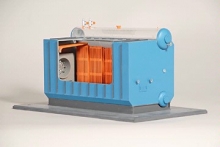 Item Number:355DAC Worldwide’s Water Tube Boiler Model (355) depicts a highly-detailed scale model of a common water tube boiler in a technically-accurate, professionally-crafted design. The model supports training in the operation and maintenance of industrial boilers found within utility systems in industrial facilities.
 -
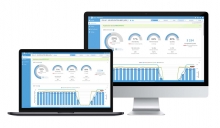 WebLytics from OnRobot is the first software solution that provides real-time production monitoring for collaborative applications across major robot brands.
 -
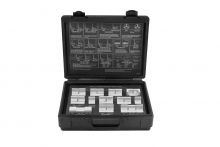 Item Number:825-000DAC Worldwide’s Weld Fault Comparison Kit (825-000) is a three-dimensional visual aid with accompanying training materials that facilitates basic training in weld quality and weld fault terminology by accurately depicting and identifying common weld defects.