Amatrol’s Portable Mechanical Drives 1 Learning System (990-ME1) covers the fundamentals of mechanical transmission systems and applications, such as how to: operate, install, analyze performance, and design basic mechanical transmission systems using chains, vbelts, spur gears, bearings, and couplings. These fundamentals can be applied to a variety of applications within the automotive, agricultural, and power industries.
Friday, November 29, 2024
Simlog’s Shipping Container Unloading module teaches safe material handling in one of the most challenging forklift tasks: working within the tight confines of a container. Operators are tested on their ability to maneuver, lift, and place loads with minimal clearance on all sides.
The demo illustrates how this scenario builds core competencies such as steering precision, load stability, and forward planning—equipping users with skills needed for ports, warehouses, and freight centers.
Friday, November 29, 2024
The Dry Van Trailer Loading module challenges trainees to operate in confined trailer spaces, simulating real-world shipping environments. Users must maintain forklift control while navigating tight clearances and stacking pallets safely inside the trailer.
This demo captures how the simulator replicates critical aspects of trailer loading—including smooth entry/exit, pallet alignment, and managing limited visibility—ensuring learners are job-ready from day one.
Friday, November 29, 2024
In the Selective Pallet Racks 1 module, operators learn how to accurately handle pallets in a high-density storage system. This simulation enhances spatial awareness, vertical lifting accuracy, and horizontal control—key skills for maintaining warehouse productivity and avoiding costly errors.
The video demonstrates how the simulator helps users build consistency and confidence when placing and retrieving pallets from various rack levels, including proper fork alignment and depth control.
Monday, January 20, 2025
Friday, November 29, 2024
The Drive-In / Drive-Through Racks module trains users on the complexities of maneuvering in tight warehouse aisles with limited visibility. This simulation emphasizes alignment, precision, and safe entry/exit from racking systems, skills essential for real-world efficiency and safety.
This demo shows operators navigating into the racking system with care, placing and retrieving loads while avoiding collisions—perfect for reinforcing best practices in space-restricted warehouse environments.
Electronics PLC Programming & Troubleshooting Training
Amatrol’s Electronics PLC Programming and Troubleshooting systems deliver industry-relevant, hands-on training with real-world components from leading manufacturers like Allen-Bradley, Siemens, and Mitsubishi. These systems teach critical automation skills including PLC operation, ladder logic programming, motor control, analog and digital I/O, event sequencing, and systematic troubleshooting—all essential for success in modern manufacturing and industrial environments.
From fully integrated workstations to portable learning systems, Amatrol offers flexible solutions that support in-depth learning in both classroom and on-site settings. Each system features interactive multimedia curriculum and FaultPro software for realistic fault insertion and diagnostics practice, ensuring learners build confidence in diagnosing and resolving real-world automation issues. Prepare students or trainees for tomorrow’s workforce with advanced PLC training that meets the needs of today’s technology.
Monday, February 5, 2024
At LIFT’s advanced manufacturing headquarters in Detroit, training the future workforce is a core mission. This video takes you inside the LIFT Learning Lab, where students engage with hands-on Amatrol training systems—from robotics and hydraulics to electronics and pneumatics. The lab features cutting-edge equipment, including the Pegasus robot, to help learners build real-world technical skills.
Hear from STEM Talent Program Manager Bernie Simms, Learning Lab Manager Jihad Mims, and Instructor Isaac Vanover as they highlight the impact of the IGNITE: Mastering Manufacturing program, developed in partnership with Amatrol. With students gaining confidence and exploring career paths in welding, automotive, and smart manufacturing, the program is truly igniting passion and purpose in the next generation of skilled workers.
Monday, March 18, 2024
This video highlights the impressive Industrial Tech-Ed program at Williams Bay High School in Wisconsin, where students gain real-world experience with advanced automation and Industry 4.0 technologies. The elective program offers hands-on training with pneumatic controls, AC/DC electrical systems, smart sensors, hydraulic systems, and industrial robotics.
Led by instructor Jacob White, the program empowers students to not only understand how each system functions but also how to integrate them creatively. By learning to think critically and problem-solve using interconnected technologies, students build a strong foundation for future careers in modern manufacturing environments.
Wednesday, March 27, 2024
Explore Ivy Tech Lafayette’s vision for the future of manufacturing in this engaging video featuring Academic Dean Bryce Eaton and student Gage Baer. Through a dynamic partnership with Amatrol, Ivy Tech Lafayette provides hands-on training in a state-of-the-art manufacturing lab that mirrors real industrial settings—including fluid power systems and advanced automation cells.
With a strong emphasis on renewable energy and smart technologies, the Energy Technology and Advanced Manufacturing programs are equipping students with the skills needed to thrive in Indiana’s growing industrial landscape. Discover how Ivy Tech is fostering innovation, sustainability, and workforce readiness in the heart of the Midwest.
Monday, April 15, 2024
Experience the future of manufacturing with Lakeshore Technical College! In this video, Dean of Applied Technology and Economic Development Rachel Kroeplien is joined by instructors Matt Roskopf and Brendo Olds for an inspiring look at how hands-on training and Industry 4.0 certifications are transforming their students' futures.
Through a powerful partnership with Amatrol and SACA (Smart Automation Certification Alliance), Lakeshore’s advanced manufacturing lab mirrors real-world industrial environments—complete with fluid power systems, robotics, and cutting-edge automation technology. Learn how Lakeshore Tech is preparing Wisconsin’s workforce for a rapidly evolving industry and helping students ignite a passion for innovation and technical careers.
Pages
-
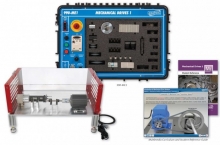 Item Number:990-ME1
 -
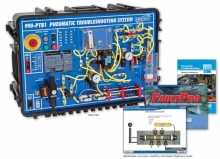 Item Number:990-PTB1This system’s value is twofold: first it provides vital training experience for learners and professionals that will perform industrial maintenance, installation, and troubleshooting on pneumatic systems used in real-world automation machinery, packaging equipment, pharmaceutical applications, chemical handling tasks, and more. Secondly, this system features industry-standard valves, switches, and gauges all within a portable learning system that can be placed on a conference room table, shop floor desk, or practically anywhere when training space is limited.
 -
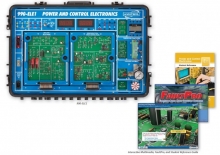 Item Number:990-ELE1Amatrol’s Portable Power and Control Electronics Learning System (990-ELE1) covers how to operate, adjust, and troubleshoot electronic components, circuits, and systems used in machine applications. The portable learning system allows for on-the-go exploration of the fundamental concepts of industrial power and control electronics, such as measuring temperature, speed, and analog signals. The 990-ELE1 provides skills and topics that will be invaluable in industries like manufacturing, transportation, energy, and construction.
 -
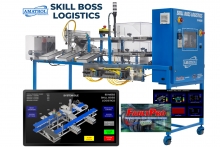 Item Number:95-MSB3The Amatrol Skill Boss Logistics offers a performance-based assessment for evaluating the skills and competencies of future supply chain automation technicians.
 -
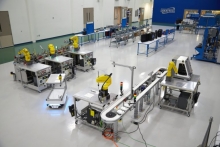 The Smart Factory is a fully connected and flexible manufacturing system that connects its physical systems, operational information, and human assets to control manufacturing, maintenance, inventory, and supply chain operations.
 -
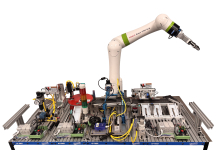 Item Number:87-TMSTrain future technicians with Amatrol’s Tabletop Smart Factory and Cobot-Integrated Mechatronics systems—hands-on, compact training with real industrial components, Rockwell Automation integration, and FANUC CRX collaborative robotics.
 -
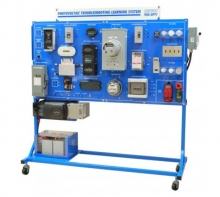 Item Number:950-SPT1The 950-SPT1 teaches students connection, operation, programming, and troubleshooting of AC/DC and grid-connected systems. The curriculum is PC-based multimedia that is highly interactive. It allows students to use the learning style best for them – reading, listening, visual. The 950-SPT1 supports the NABCEP (North American Board of Certified Energy Practitioners) test for Certified Solar Photovoltaic System Installer.
 -
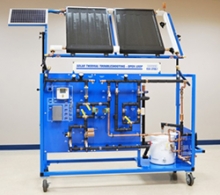 Item Number:950-STOL1The 950-STOL1 includes all components needed to develop hands-on, job ready skills: all solar specific components as well as balance of system items. The learning system contains a mobile workstation, multiple component circuit panels, a solar collector unit, fault insertion, PC-based multimedia student curriculum, and instructor’s assessment guide. An optional sun simulator is available to facilitate classes indoors when outdoor conditions do not support solar heating.
 -
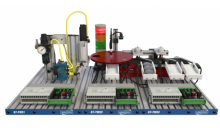 Item Number:870-PTAB82Amatrol’s Tabletop Mechatronics is a portable, durable, affordable learning system that forms a fully automated line to teach real-world mechatronics skills. This learning system features a pick-and-place, gauging, and inventory station, all of which fit on a standard tabletop!
 -
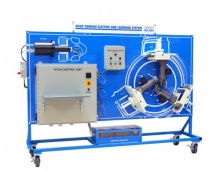 Item Number:950-TEH1Amatrol's 950-TEH1 Turbine Electric Hub Troubleshooting Learning System teaches students adaptive skills for wind turbine operation, adjustment, and troubleshooting in a wide variety of situations. The 950-TEH1 allows students to develop and practice component, subsystem, and system-level skills. The fully functional, scaled-down utility-scale turbine electric hub. The Turbine Electric Hub Troubleshooting Learning System includes...