





Amatrol’s High School Learning Systems create the need for students to want to learn math and science – they can’t interact with the exciting technology without it. Learning is interactive and challenging, keeping them engaged and wanting to do more. The math and science so desperately needed for 80% of jobs today is a natural outcome.
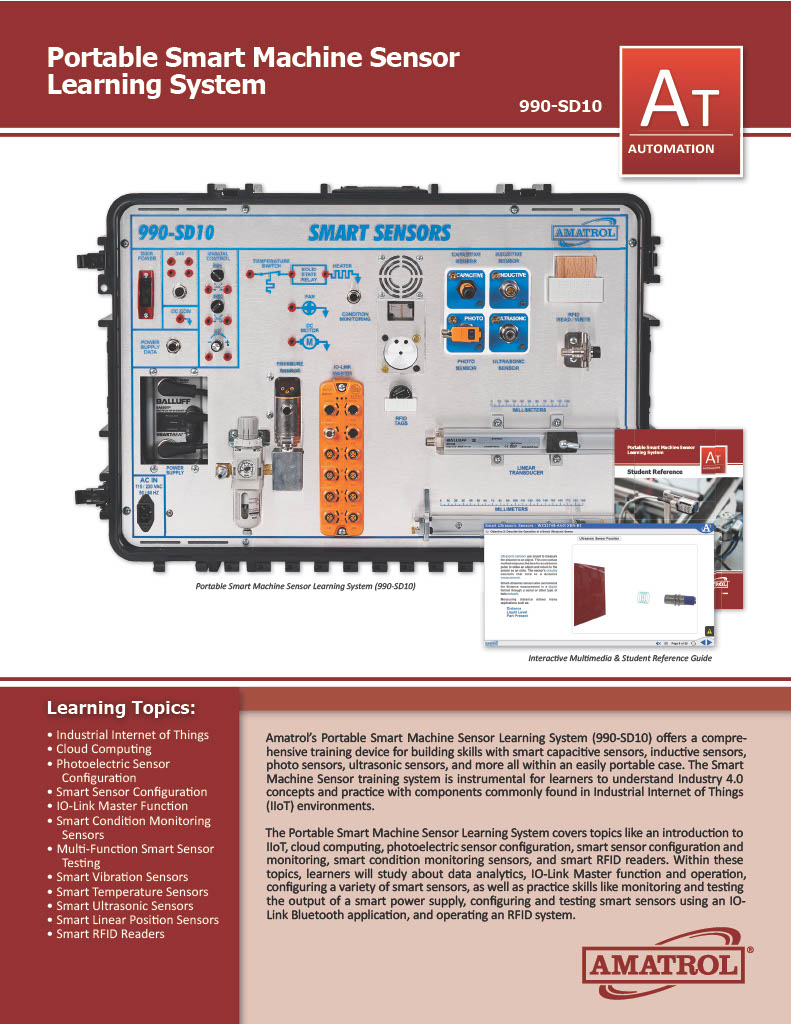
Amatrol’s Portable Smart Machine Sensor Learning System (990-SD10) is an innovative, compact training solution designed to equip learners with cutting-edge Industry 4.0 skills. Featuring real-world components and advanced eLearning, this portable system allows users to practice configuring and testing smart sensors, exploring IIoT environments, and mastering cloud computing applications—all in a durable, mobile training kit.
The Portable Smart Machine Sensor Learning System covers topics like an introduction to IIoT, cloud computing, photoelectric sensor configuration, smart sensor configuration and monitoring, smart condition monitoring sensors, and smart RFID readers. Within these topics, learners will study about data analytics, IO-Link Master function and operation, configuring a variety of smart sensors, as well as practice skills like monitoring and testing the output of a smart power supply, configuring and testing smart sensors using an IO-Link Bluetooth application, and operating an RFID system.
Comprehensive Learning Topics
Gain hands-on experience with concepts and tools critical to Industry 4.0:
- Industrial Internet of Things (IIoT)
- Cloud Computing
- Photoelectric Sensor Configuration
- Smart Condition Monitoring Sensors
- IO-Link Master Function
- Smart RFID Readers and Components
This training system allows learners to build essential skills for careers in Smart Factory environments, including:
- Operating RFID systems
- Configuring and testing smart sensors (e.g., ultrasonic, photoelectric, vibration, and linear position sensors)
- Monitoring outputs using IO-Link software and Bluetooth applications
With real-world components like smart power supplies, IO-Link Masters, and multi-function smart sensors, students are prepared to tackle challenges in the growing field of industrial automation and IIoT.
Portability & Durability
Designed for mobility, this trainer comes housed in a durable ABS plastic case with wheels and a handle for easy transportation. Setup is quick and intuitive—just remove the cover, and the trainer is ready to use.
World-Class eLearning
Amatrol’s interactive multimedia curriculum includes voiceovers, videos, 3D animations, and quizzes to make learning engaging and effective. Topics like predictive maintenance, Lean Manufacturing, and smart sensor operation are brought to life with stunning visuals and real-world applications.
Student Reference Guide
The included Smart Sensors Student Reference Guide condenses the system’s technical content into a bound book, creating an invaluable takeaway for learners to reference long after completing their training.
Start Building Industry 4.0 Expertise Today!
Download the brochure to discover how the Portable Smart Machine Sensor Learning System can transform your training program. Explore its cutting-edge features, innovative curriculum, and unparalleled ease of use.
Amatrol’s Portable Smart Process Sensor Learning System (990-SD20) teaches the operation and function of a variety of smart process sensors, including smart analog pressure sensors, smart electromagnetic flow sensors, smart ultrasonic level sensors, and smart point level sensors. Students will also gain an understanding of the Industrial Internet of Things (IIoT) and cloud computing.
This portable system provides hands-on experience with real-world components, including an IO-Link Master, smart sensor PC software, and applications for analog flow, analog level, and hi/lo level sensing. Students will study industry-relevant applications and learn hands-on skills that will build a strong foundation for a successful career in a variety of industries that use advanced process control technologies.
Amatrol’s Smart Manufacturing Learning System (990-SM10) was developed in partnership with CESMII - The Smart Manufacturing Institute, to answer the call for hands-on learning in Smart Manufacturing and Industry 4.0 technologies. Combining hardware, industrial software products and solutions, and in-depth exercises, this system has been designed to educate and equip learners at all levels of expertise, from the novice ‘Citizen OT-IT Technologist’ to the expert architect and implementer of smart manufacturing systems.
Proximity, Magnetic, & Photoelectric Sensors
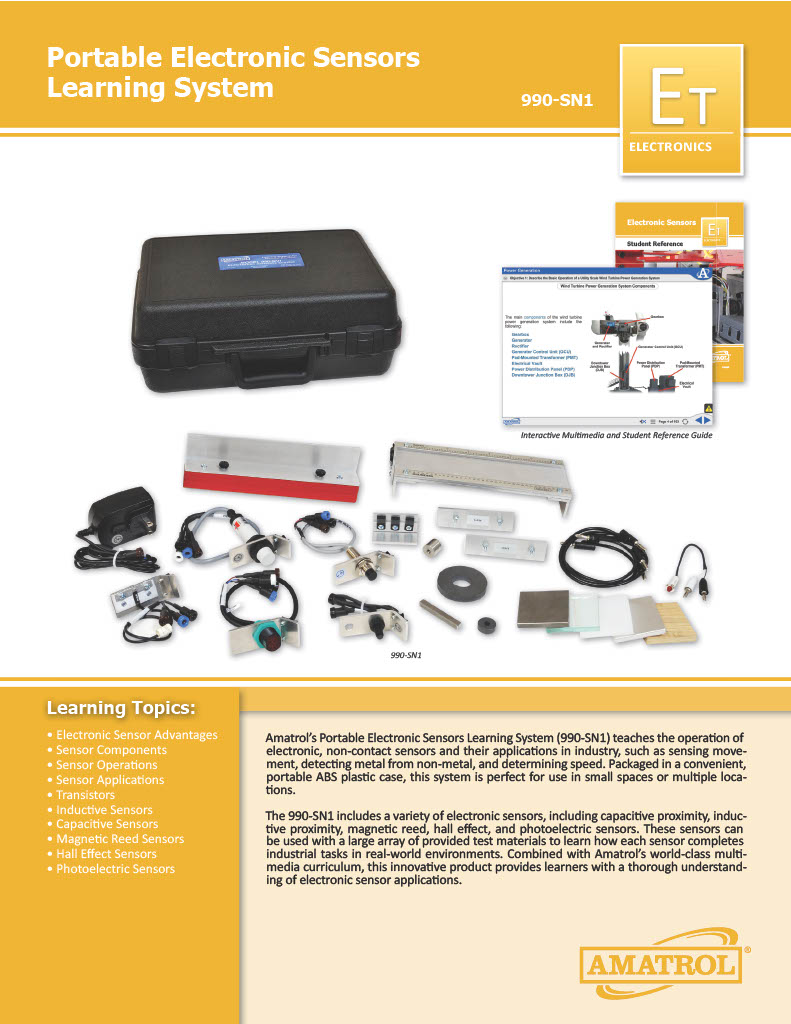
Amatrol’s Portable Electronic Sensor Training System (990-SN1) teaches the operation of electronic, non-contact sensors and their applications in industry, such as sensing movement, detecting metal from non-metal, and determining speed. Packaged in a convenient, portable ABS plastic case, this system is perfect for use in small spaces or multiple locations.
The portable electronic sensors training system includes a variety of electronic sensors, including capacitive proximity, inductive proximity, magnetic reed, hall-effect, and photoelectric sensors. These sensors can be used with a large array of provided test materials to learn how each sensor completes industrial tasks in real-world environments. Combined with Amatrol’s world-class multimedia curriculum, this innovative product provides learners with a thorough understanding of electronic sensor applications.
Tabletop Mechatronics Option
Add Amatrol’s Stepper Motor Programming Package (45058) to the Smart Factory Tabletop Mechatronics System to teach valuable motor programming skills.
Amatrol’s Smart Factory Tabletop Mechatronics System provides a fantastic introduction to Industry 4.0 training for high schools. When training space or budget limitations don’t allow for installation of a full Mechatronics line, the Smart Factory Tabletop Mechatronics System packs a wide variety of essential training topics and hands-on skills into an affordable, compact training system.
Amatrol’s Combined Refrigeration Installation Learning System (T7200) offers a comprehensive hands-on workstation and interactive multimedia curriculum to teach installation of electrical and mechanical refrigeration/air conditioning components in residential or light commercial applications. This system in an ideal training tool for future HVACR technicians.
The Combined Refrigeration Installation Learning System includes evaporator and condenser coils, a hermetically-sealed compressor, a filter/drier, and many more real-world industrial components that allows learners to practice skills with components that they’ll find on-the-job. The included multimedia curriculum covers topics like: copper tubing, refrigerant line routing and bending, flaring and swaging copper tubing, brazing and soldering refrigerant lines, and copper tubing insulation.
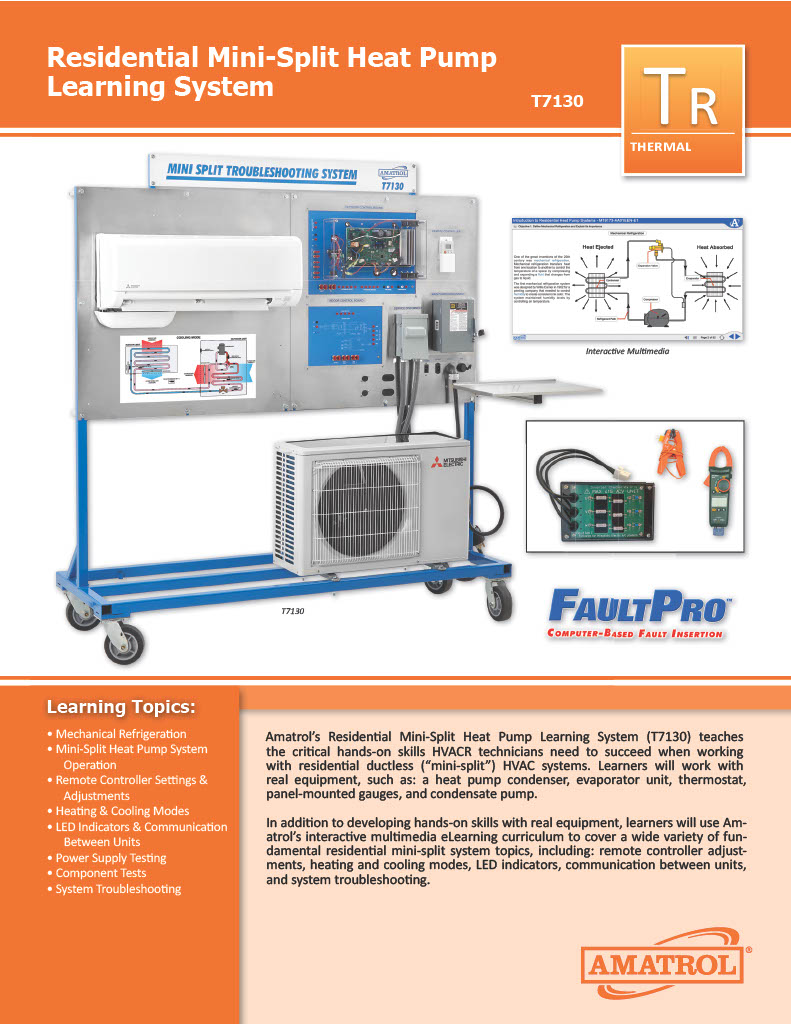
Amatrol’s Residential Mini-Split Heat Pump Learning System (T7130) teaches the critical hands-on skills HVACR technicians need to succeed when working with residential ductless (“mini-split”) HVAC systems. Learners will work with real equipment, such as: a heat pump condenser, evaporator unit, thermostat, panel-mounted gauges, and condensate pump.
In addition to developing hands-on skills with real equipment, learners will use Amatrol’s interactive multimedia eLearning curriculum to cover a wide variety of fundamental residential mini-split system topics, including: remote controller adjustments, heating and cooling modes, LED indicators, communication between units, and system troubleshooting.
Caracol was born from the idea of pushing the limits of AM, beyond what was possible.
That idea was brought to life by evolving the possibilities of Additive Manufacturing on scale, shape, and materials with HERON AM.
HERON AM is Caracol's Large-Format Additive Manufacturing system: a robotized extrusion head, with direct and continuous feeding of composites and polymers, a dedicated software platform for the most complex tool paths, and many more features to fully integrate all that is needed to manufacture advanced industrial parts.
The solution is one of the leading LFAM systems in the world, and the only one that is offered as a turnkey solution to maximize flexibility, process control, and performance for clients who want to manufacture parts on-demand and in-situ.
Caracol keeps pushing LFAM ahead expanding its solutions on metals.
The beauty of additive manufacturing is flexibility these technologies provide in terms of scale, shape and materials.
Starting from the expertise Caracol developed in advanced robotics programming, computational design, slicing, and path planning, they are leveraging these skills and applying them to a completely different process and material: DED, and specifically wire arc additive manufacturing (WAAM).
Together with leading research centers and players in the most advanced manufacturing sectors, we have been working on several research projects, with the aim of using this technology to produce large, finished parts with metals for sectors such as aerospace, railways and energy.
WSU Enhances AM Learning with Stratasys F370®CR Composite 3D Printer
About Weber State University
The Advanced Research and Solutions Center at Weber State University is an innovation and collaboration area for local industry, primarily in the aerospace, defense, and advanced materials sectors. In addition, the center provides access to R&D resources that include additive manufacturing while offering educational and practical opportunities for students.
The Challenge
Providing students and local industry with the best opportunities for success requires access to current and emerging technologies, including additive manufacturing. However, existing WSU additive capabilities relied on older 3D printers, which were slow and costly to operate, with few material options. This situation limited WSU's Advanced Research and Solution Center's ability to meet student and local industry needs.
The Solution: Composite 3D Printing
To strengthen its 3D printing capabilities, the university added a Stratasys F370®CR composite 3D printer to complement its manufacturing and fabrication equipment.
The F370CR operates with two composite materials and several other engineering-grade thermoplastics. The composite 3D printing materials include FDM® Nylon-CF10 and ABS-CF10, which incorporate 10% chopped carbon fiber for added strength and rigidity.
Composite 3D Printing at Weber State University
Adding the F370CR printer gives WSU the capabilities of a current-technology 3D printer with more material options, including advanced composite polymers. The F370CR 3D printer’s ease of use and consistent printing performance gives users a faster, more reliable means of developing 3D printed solutions.
Ultimately helping WSU achieve the facility’s goal of providing innovative and leading-edge tools for its current and future students and customers.
Read the Complete Use Case!
Download the case study and discover how WSU accelerated its 3D printing capabilities with the Stratasys F370®CR composite printer, providing students with a reliable and efficient solution for their projects.
Pages
-
-
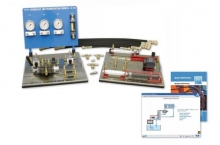 Item Number:BH-85Each Basic Hydraulics training system features standard industrial grade components. This attention to quality gives students experience they would normally only get on-the-job by helping them recognize industrial components and how to troubleshoot them more effectively. Components included with Basic Hydraulics are pre-mounted on circuit panels with silk-screened labels next to each, which facilitates ease of use and identification.
 -
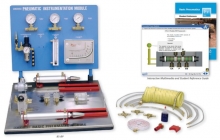 Item Number:85-BPAmatrol’s Basic Pneumatics training system (85-BP) introduces pneumatic principles through a combination of Amatrol’s top-flight multimedia curriculum with hands-on industrial pneumatic skill-building. Topics covered in this learning system include single-acting cylinder circuits, pressure vs. cylinder force, and flow control valves, while the panels can be used to practice skills such as connecting and operating a needle valve to control actuator speed.
 -
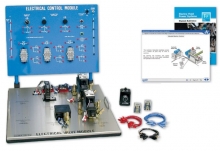 Item Number:85-EHThe Electro-Hydraulics training system includes an electrical control panel with relay control components and an electrical valve module with solenoid-operated hydraulic directional control valves and electrical/electronic sensors. These components will be used to study a variety of topics including electrical control systems, basic control devices, power devices, control relays, sequencing control, timer control, pressure control applications, and circuit applications.
 -
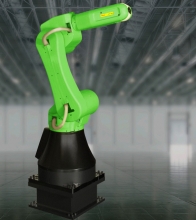 Item Number:CR-35iAFANUC’s new CR-35iA is the world’s first collaborative robot with a payload capacity of up to 35 kg. Fenceless, it opens a whole new world of possibilities. Working safely side by side with human operators, it is space as well as cost saving. And because inside it’s like any other FANUC robot, it operates like all FANUC robots. Certified to meet the requirements of ISO 10218-1:2011 and RIA/ANSI R15.06-2012, FANUC’s CR-35iA collaborative robot can work in a variety of applications alongside human workers including: machine tending, handling heavy payloads that require lift assist devices or custom equipment, higher payload mechanical assembly, palletizing or packing, and tote or carton handling.
 -
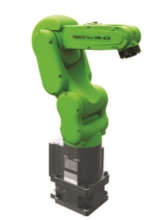 Item Number:CR-4iACR-4iA is a small collaborative robot with 4 kg payload
 -
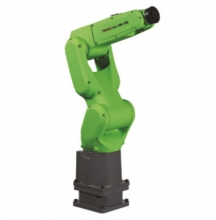 Item Number:CR-7iAThe FANUC CR-7iA is FANUC's newest collaborative robot resembles the LR Mate family. Painted green to show it's ability to work beside humans, you can expect the same reliability as FANUC's yellow robots. The CR-7iA is ideal for small part sorting and assembly, inspection, machine tending, and part delivery. It has a 7 kg payload, 717 mm reach, and is equipped with iRVision and Force Sensing. There are a variety of mounting options such as floor, wall, and ceiling.
 -
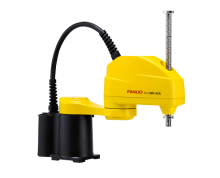 FANUC’s new SCARA robots are ideal for high-speed, precision applications such as assembly, pick and place, testing/inspection and packaging processes.
 -
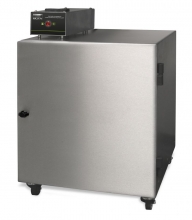
In the rare event that a burning ember or spark is drawn into the fume extraction unit, there is the possibility that debris in the filters could ignite. Although any resultant fire would typically be retained within the fume extraction unit, this would cause significant damage and in extreme circumstances, the risk may extend beyond the extraction unit. For processes where such risks have been identified, additional protection in the form of an in-line firebox is an additional precaution.
-
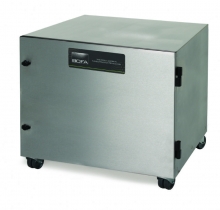
The BOFA inline pre-filter 1000 has been designed specifically for applications that generate high amounts of dust or particulate.
This inline filter unit is positioned alongside the main BOFA fume filtration system to increase the overall filter capacity and extend the life of the main filters. The DeepPleat DUO pre-filter incorporates a massive drop-out chamber within the filter, having a volume area of 15ltrs. Above the drop-out chamber but still within the housing there is a sealed 200mm deep pleat layer of F8 media giving a surface area in excess of 30 sq meters.