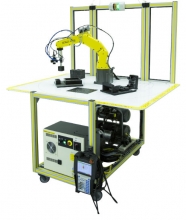
The NEW FANUC LR Mate 200iD/4S Fenceless CERT Cart was developed from combining FANUC DCS Position and Speed Check software with an Allen Bradley SafeZone Mini Safety Laser Scanner. The result is FANUC’s NEW Fenceless Cart that will still fit through a standard door and runs off 110V power. The Fenceless cart allows a greater work envelope and introduces students to the latest in integrated safety products from FANUC and Allen Bradley.
The Standard in Cost-Effective Simulation for Training Heavy Equipment Operators
Simlog Personal Simulators have been delivering cost-e ective training simulation to education and industry since 1999. Today, our Personal Simulators are used in over 500 vocational programs. Simlog Personal Simulators have helped place hundreds of thousands of students around the world on a pathway to becoming superior heavy equipment operators.
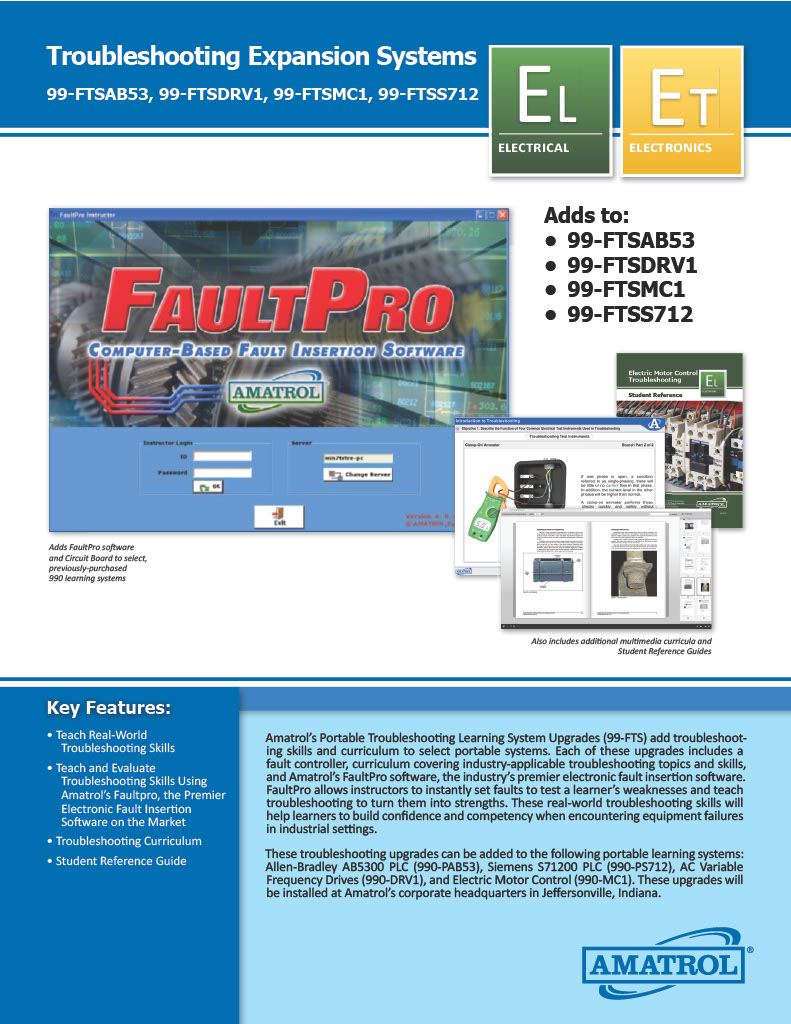
Amatrol's Portable Troubleshooting Learning System Upgrades (99-FTS) add troubleshooting skills and curriculum to select portable systems. Each of these upgrades includes a fault controller, curriculum covering industry-applicable troubleshooting topics and skills, and Amatrol's FaultPro software, the industry's premier electronic fault insertion software. FaultPro allows instructors to instantly set faults to test a learner's weaknesses and teach troubleshooting to turn them into strengths. These real-world troubleshooting skills will help learners to build confidence and competency when encountering equipment failures in industrial settings.
Adds to:
- 99-FTSAB53
- 99-FTSDRV1
- 99-FTMC1
- 99-FTSS712
Portable V-Belt & Synchronous Belt Training System
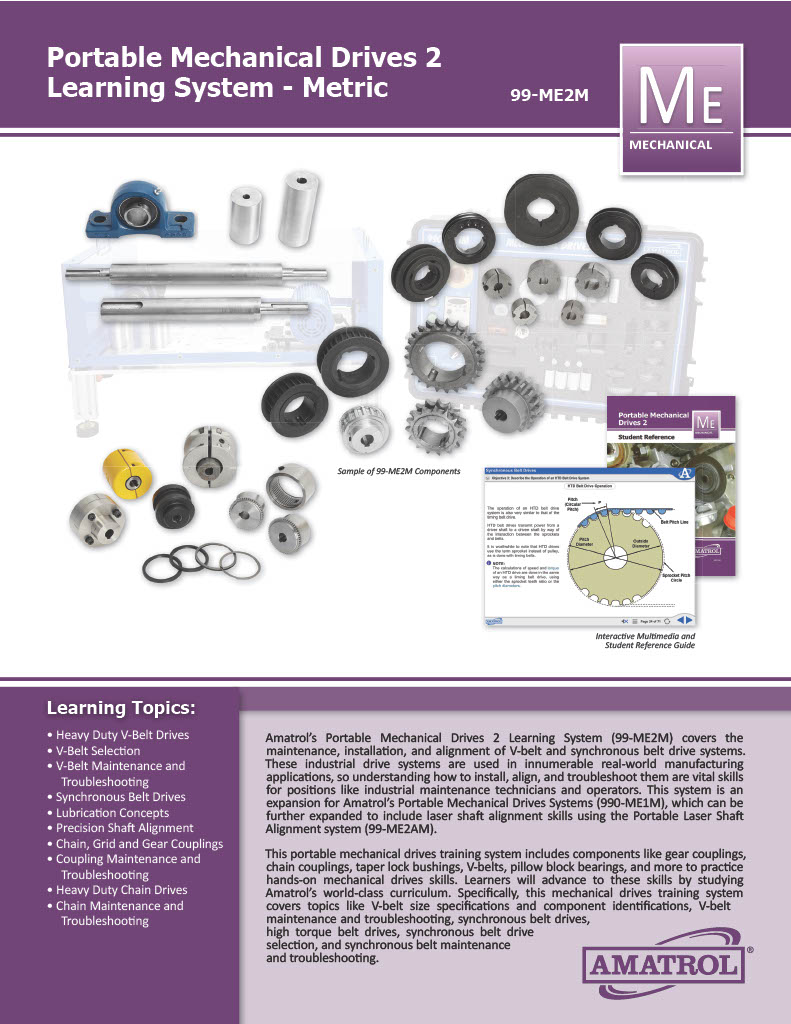
Amatrol’s Portable Mechanical Drives 2 Learning System (99-ME2M) covers the maintenance, installation, and alignment of V-belt and synchronous belt drive systems. These industrial drive systems are used in innumerable real-world manufacturing applications, so understanding how to install, align, and troubleshoot them are vital skills for positions like industrial maintenance technicians and operators. This system is an expansion for Amatrol’s Portable Mechanical Drives Systems (990-ME1M), which can be further expanded to include laser shaft alignment skills using the Portable Laser Shaft Alignment system (99-ME2AM).
This portable mechanical drives training system includes components like gear couplings, chain couplings, taper lock bushings, V-belts, pillow block bearings, and more to practice hands-on mechanical drives skills. Learners will advance to these skills by studying Amatrol’s world-class curriculum. Specifically, this mechanical drives training system covers topics like V-belt size specifications and component identifications, V-belt maintenance and troubleshooting, synchronous belt drives, high torque belt drives, synchronous belt drive selection, and synchronous belt maintenance and troubleshooting.
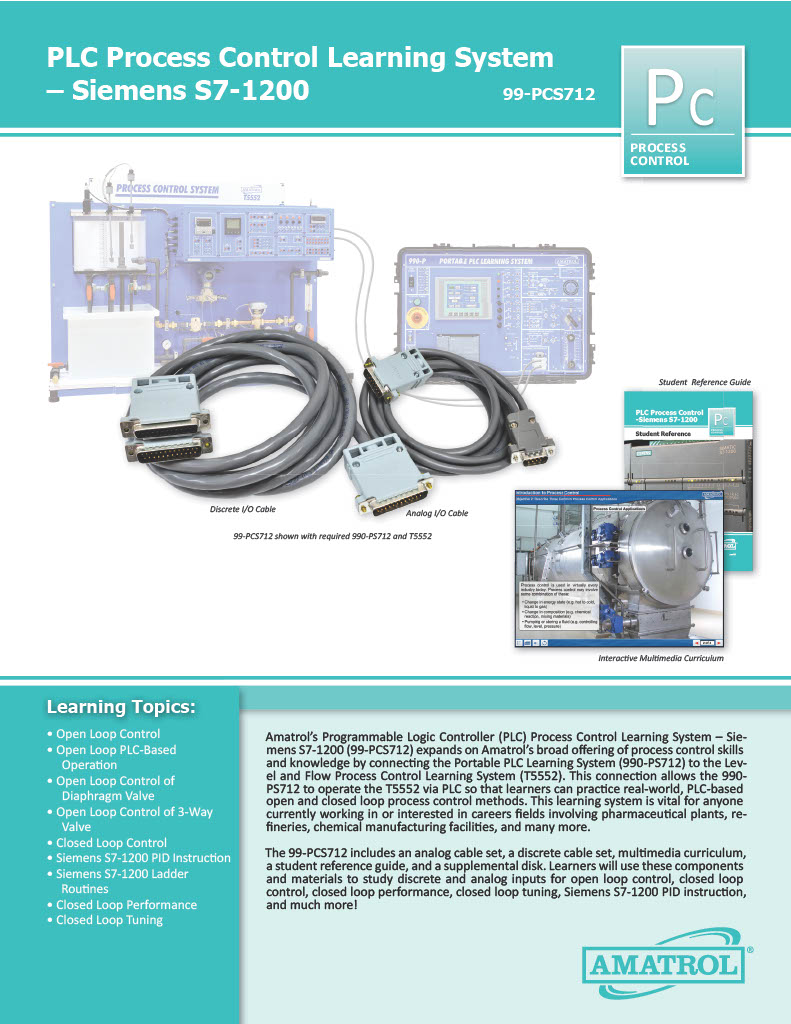
Amatrol's Programmable Logic Controller (PLC) Process Control Learning System - Siemens S7-1200 (99-PCS712) expands on Amatrol's broad offering of process control skills and knowledge by connecting the Portable PLC Learning System (990-PS712) to the Level and Flow Process Control Learning System (T5552). This connection allows the 990-PS712 to operate the T5552 via PLC so that learners can practice real-world, PLC-based open and closed loop process control methods. This learning system is vital for anyone currently working in or interested in career fields involving pharmaceutical plants, refineries, chemical manufacturing facilities, and many more.
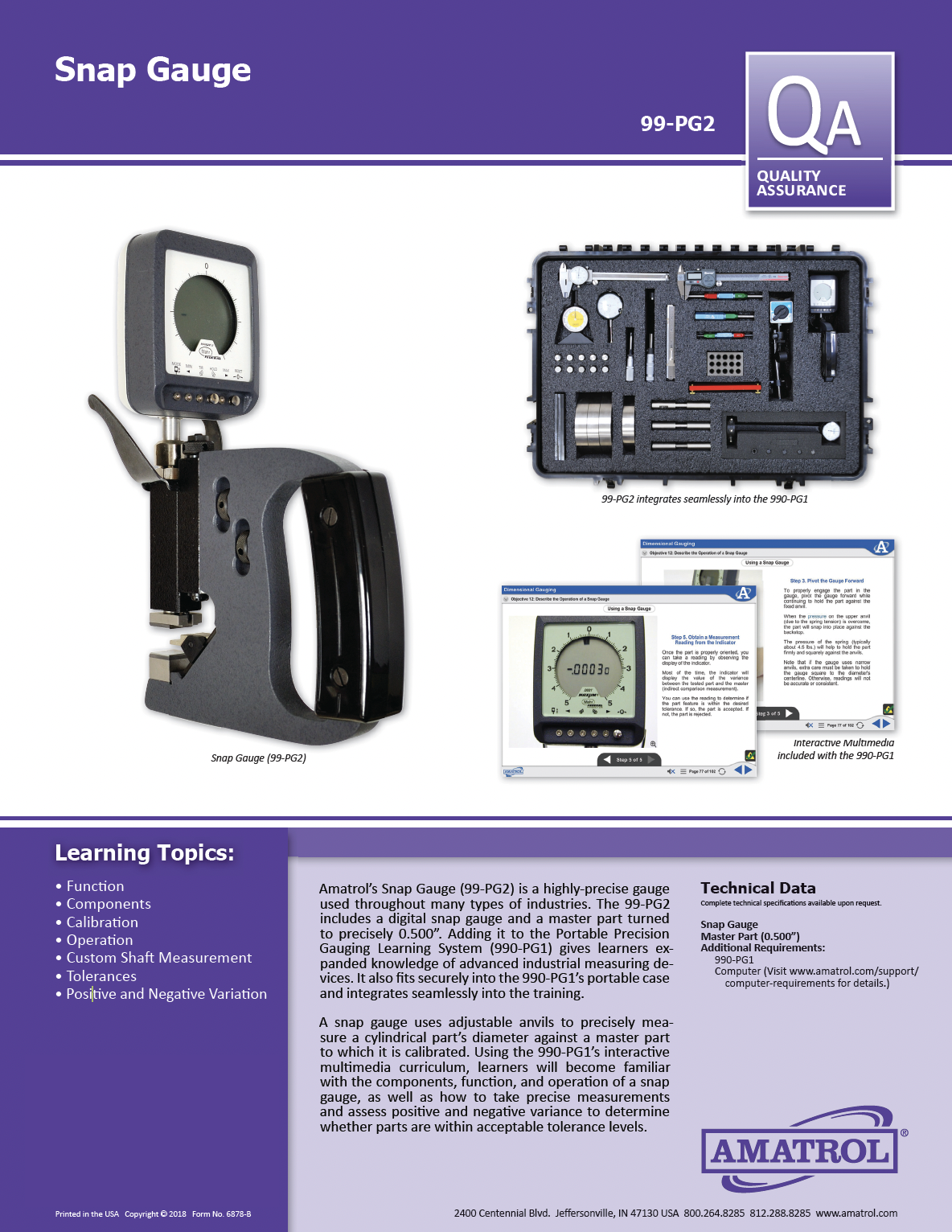
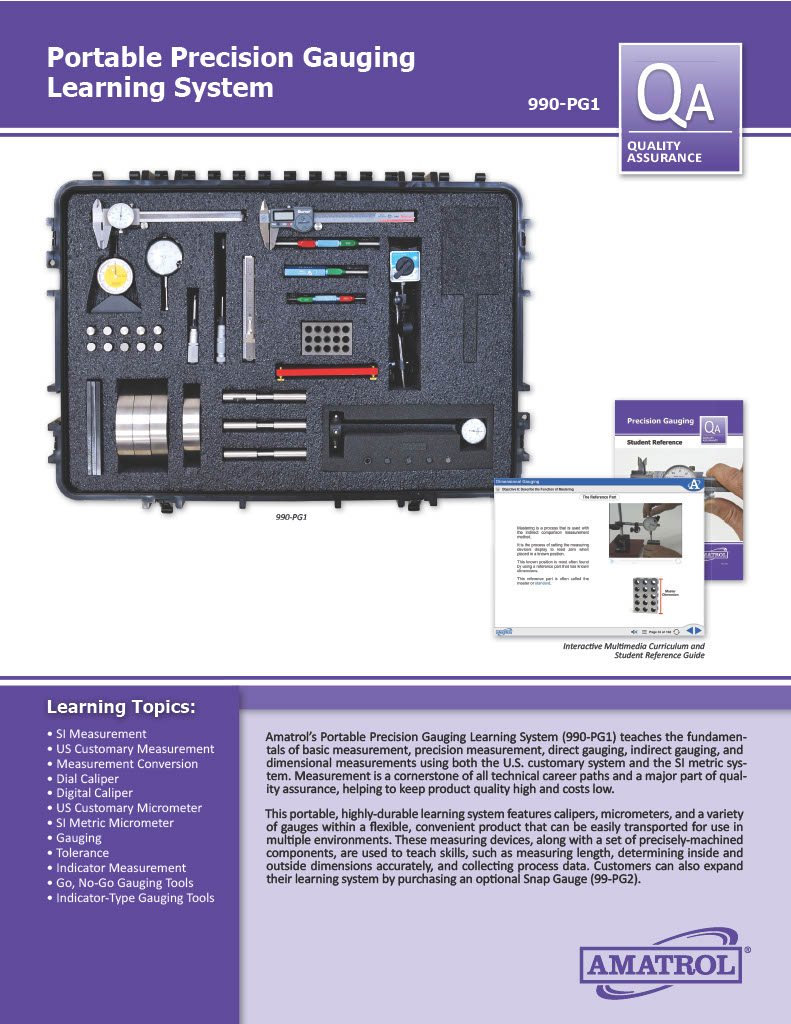
Customers who want experience with more advanced gauges can expand Amatrol’s Portable Precision Gauging Learning System by adding an optional Snap Gauge (99-PG2). A snap gauge uses adjustable anvils to precisely measure a cylindrical part’s diameter against a master part to which it is calibrated. The learning system’s interactive curriculum includes a section on how to use a snap gauge. The 99-PG2 Snap Gauge fits securely into the 990-PG1’s portable case and integrates seamlessly into the training.
Amatrol’s Portable Precision Gauging Learning System (990-PG1) covers the fundamentals of basic measurement, precision measurement, direct gauging, indirect gauging, and dimensional measurements using both the U.S. customary system and the SI metric system all within a mobile, highly durable product. Measurement is a cornerstone of all technical career paths and a major part of quality assurance, which helps to keep product quality high and costs low.
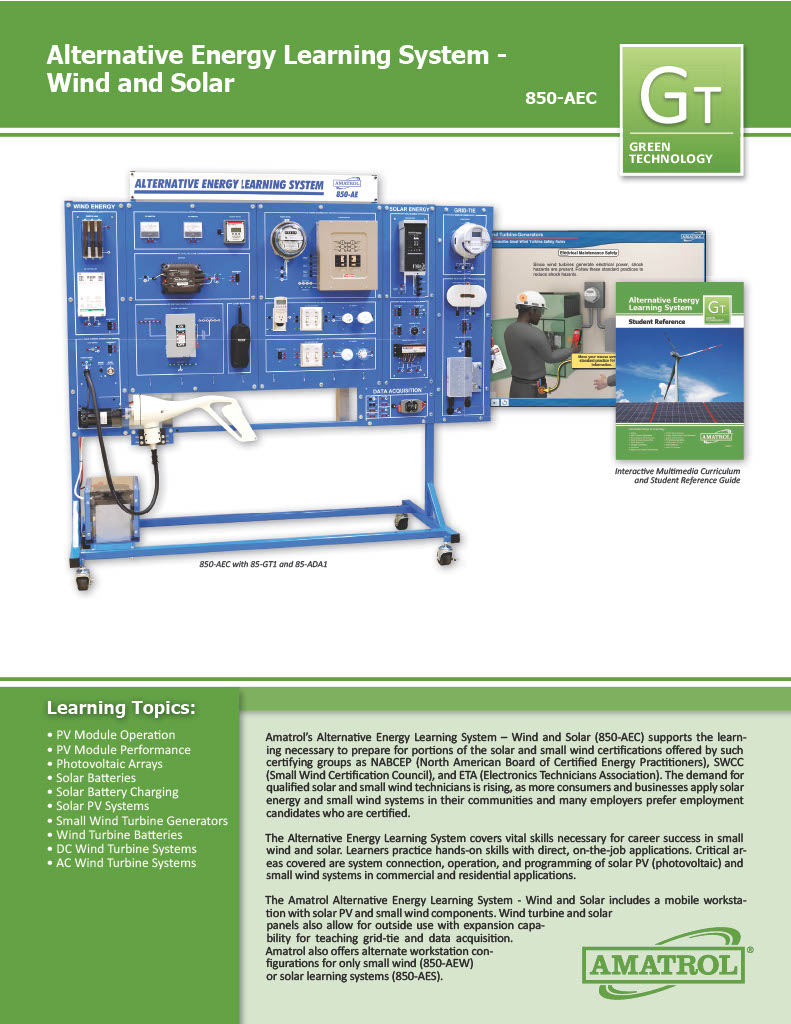
Amatrol's Alternative Energy Learning System - Wind and Solar (850-AEC) supports the learning necessary to prepare for portions of the solar and small wind certifications offered by such certifying groups as NABCEP (North American Board of Certified Energy Practitioners), SWCC (Small Wind Certification Council), and ETA (Electronics Technicians Association). The demand for qualified solar and small wind technicians is rising, as more consumers and businesses apply solar energy and small wind systems in these communities and many employers prefer employment candidates who are certified.
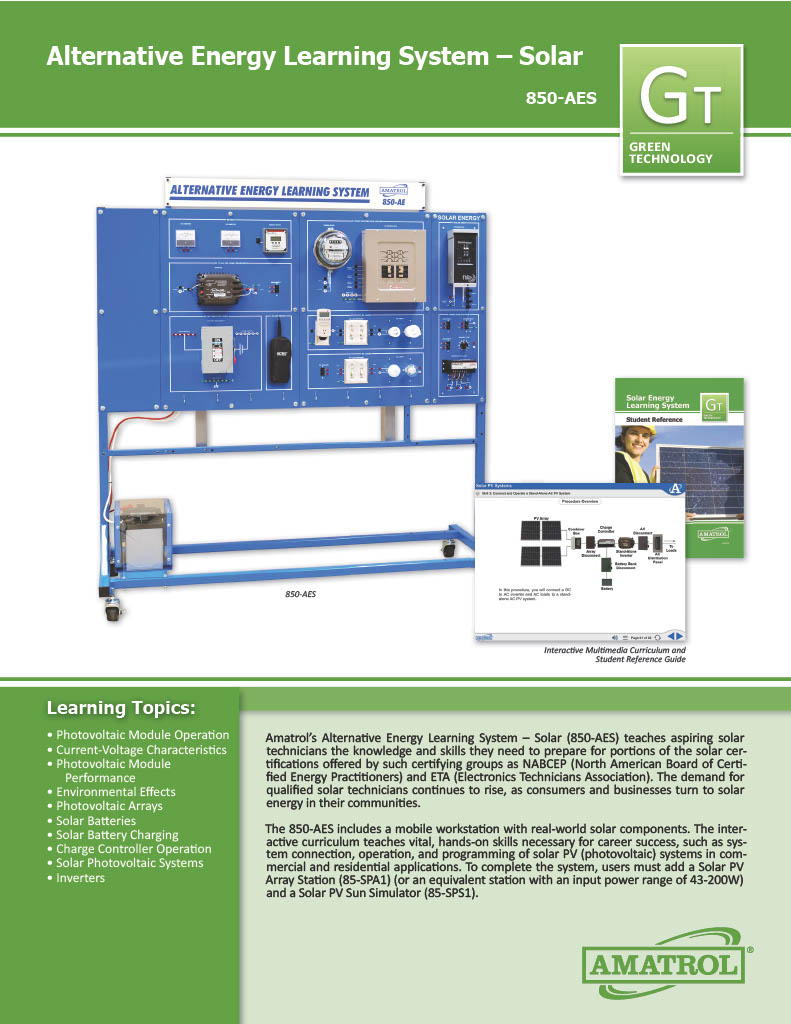
Amatrol’s Alternative Energy Learning System –Solar (850-AES) teaches aspiring solar technicians the knowledge and skills they need to prepare for portions of the solar certifications offered by such certifying groups as NABCEP (North American Board of Certified Energy Practitioners) and ETA (Electronics Technicians Association). The demand for qualified solar technicians continues to rise, as consumers and businesses turn to solar energy in their communities.
The 850-AES includes a mobile workstation with real-world solar components. The interactive curriculum teaches vital, hands-on skills necessary for career success, such as system connection, operation, and programming of solar PV (photovoltaic) systems in commercial and residential application. To complete the system, users must add a Solar PV Array Station (85-SPA1) (or an equivalent station with an input power range of 43-200W) and a Solar PV Sun Simulator (85-SPS1).
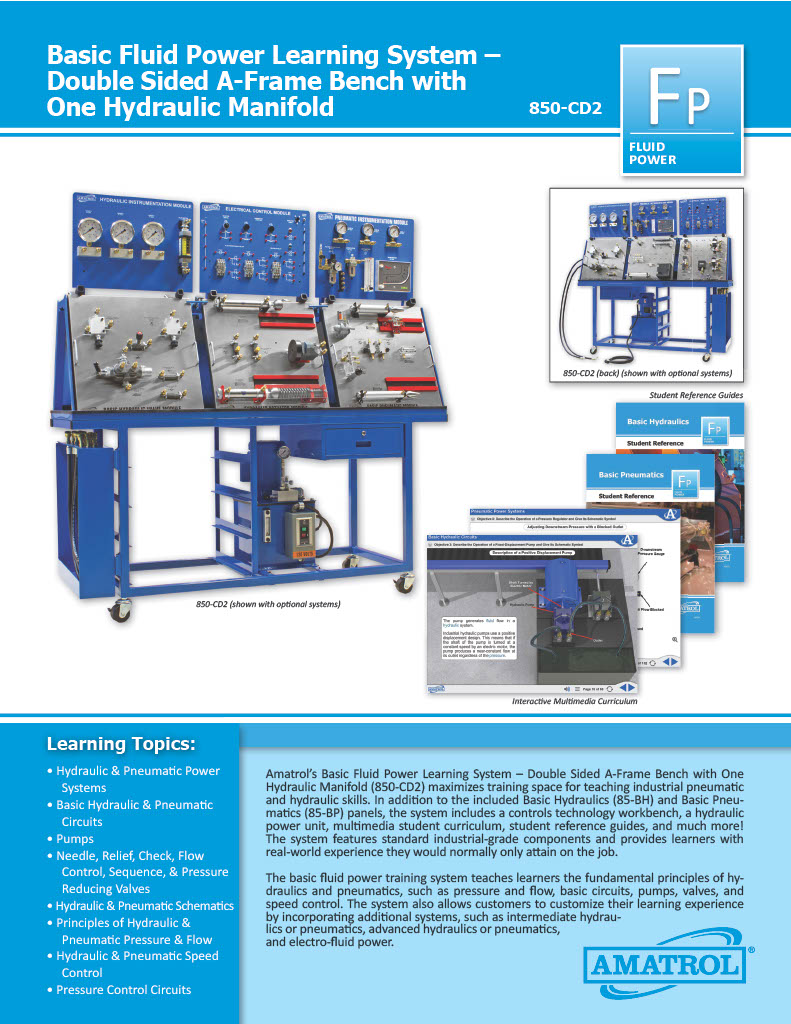
Amatrol’s Basic Fluid Power Learning System – Double Sided A-Frame Bench with One Hydraulic Manifold (850-CD2) maximizes training space for teaching industrial pneumatic and hydraulic skills. In addition to the included Basic Hydraulics (85-BH) and Basic Pneumatics (85-BP) panels, the system includes a controls technology workbench, a hydraulic power unit, multimedia student curriculum, student reference guides, and much more! The system features standard industrial-grade components and provides learners with real-world experience they would normally only attain on the job.
The basic fluid power training system teaches learners the fundamental principles of hydraulics and pneumatics, such as pressure and flow, basic circuits, pumps, valves, and speed control. The system also allows customers to customize their learning experience by incorporating additional systems, such as intermediate hydraulics or pneumatics, advanced hydraulics or pneumatics, and electro-fluid power.
Pages
-
-
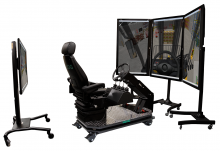 Item Number:FLTSimlog's Forklift Personal Simulator puts trainees at the controls of a typical factory forklift with rear-wheel steering. Challenging training scenarios reproduce the productivity demands of modern factory, warehouse, and distribution center environments. Our intelligent Instructional Design will guide your trainees through a series of 7 skill-building Simulation Modules that emphasize safety in every exercise.
 -
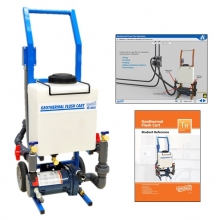 Item Number:95-GEO3Amatrol’s Geothermal Flush Cart Learning System (95-GEO3) teaches how to purge debris and air from the geothermal loop and then charge it with a glycol/water solution
 -
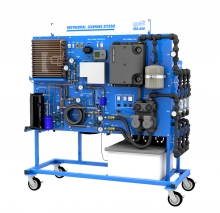 Item Number:950-GEO1Amatrol’s 950-GEO1 Geothermal Energy Training System enables learners to understand and apply their newly obtained technician skills in the ever-growing area of geothermal energy.
 -
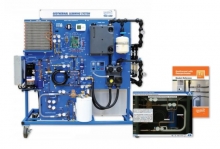 Item Number:950-GEO1DAmatrol’s 950-GEO1 Geothermal Energy Training System enables learners to understand and apply their newly obtained technician skills in the ever-growing area of geothermal energy.
 -
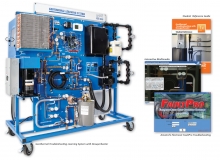 Item Number:950-GEO2DAmatrol’s 950-GEO2D Geothermal Troubleshooting Learning System with Desuperheater uses an exposed component layout so that learners can see each component’s role in a geothermal system.
 -
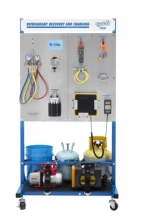 Item Number:T7031With Amatrol’s Refrigerant Recovery and Charging Learning System for R-134a, you can train future HVAC/R technicians hands-on the critical technical skills required for a successful career. Students will work with real equipment, including a recovery machine, manifold gauges, submersible cooler, temperature probe, filter dryer, low side liquid charger, vacuum pump, and micron vacuum gauge.
 -
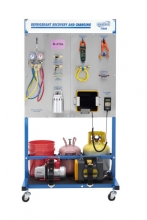 Item Number:T7032Teach aspiring HVAC/R technicians the critical technical skills needed to succeed on the job with Amatrol’s Refrigerant Recovery and Charging Learning System for R-410a (T7032). Students will work with real equipment, including a recovery machine, manifold gauges, submersible cooler, temperature probe, filter dryer, liquid vaporizer, low side liquid charger, vacuum pump, and micron vacuum gauge.
 -
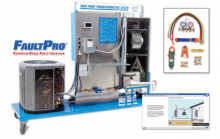 Item Number:T7100Amatrol’s Residential Heat Pump Troubleshooting Learning System (T7100) is used to teach hands-on the critical skills HVAC/R technicians need to succeed when working with residential HVAC systems that use a heat pump and traditional ducting. Students will work with real equipment, including a heat pump condenser, heat pump air handler, Wi-Fi-enabled thermostat, fuse box, ducting, and manifold.
 -
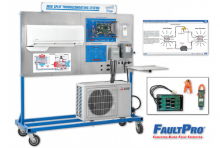 Item Number:T7130With Amatrol’s Residential Mini-Split Heat Pump Learning System (T7130) you can teach the critical hands-on technical skills HVAC/R technicians need when working with residential ductless (“mini-split”) HVAC systems. Students will work with real equipment, including a heat pump condenser, evaporator unit, thermostat, panel-mounted gauges, and condensate pump.