
A full cutaway view of the valve body exposes the complete internal design characteristics, flow path, valve stem, compressor connection, backseat, front-seat, packing and gauge port, while retaining its operational characteristics.
Course Summary
In numerous industrial and warehouse environments, forklifts play a vital role in moving heavy goods and materials. Operating them correctly is not only essential for efficiency but also crucial for the safety of operators and fellow workers. According to the Occupational Safety and Health Administration (OSHA), there are approximately 85 fatal forklift accidents yearly in the United States, with 34,900 incidents resulting in severe injury. Adequate training can significantly reduce these numbers. This course aims to offer comprehensive training on the secure and effective operation of forklifts.
Key Learning Objectives
This course prioritizes educating workers on the best practices and safety protocols linked to forklift operation. Participants will gain expertise in:
- Understanding the fundamental mechanics and components of a forklift
- Executing safe operating procedures, encompassing starting, moving, loading, and unloading
- Mastering techniques for making tight turns while maneuvering a forklift
- Properly stacking and de-stacking loads at elevated levels
- Following prescribed "rules of the road" during forklift operation
The Forklift Operation course suits both novices and seasoned operators, as well as supervisors overseeing warehouse or industrial operations.
Simulation Specifications
Industry: General Industry
Duration: 15-20 minutes
Language: English
Headset Compatibility: Our training modules are deployable on most major headset models available in the market.
Are conventional training approaches falling short in meeting your industry's demands? Enter Hard Hat VR, the revolutionary solution for immersive, interactive training. Bid farewell to outdated methods and embrace the safety and efficacy of Virtual Reality!
Why Opt for Hard Hat VR?
- Immersive Scenarios: Experience training in realistic environments minus the actual risks.
- Interactive Education: Engage in hands-on learning that truly sticks.
- Flexible Learning Styles: Adapt training to suit diverse learning preferences and styles.
- Trackable Results: Monitor and assess progress with measurable and trackable outcomes.
- Cost Efficiency: Cut down on training costs and reduce downtime.
- Safety Priority: Get ready for real-world hazards within a controlled setting.
Who Can Benefit?
- Industrial Corporations
- Safety Training Experts
- Technical Education Institutions
Maximize Your Returns
- Enhanced Training Efficiency
- Improved Employee Safety
- Heightened Retention Rates
Stokes Robotics proudly presents the GO1 Line, a groundbreaking series designed to revolutionize learning experiences in classrooms and educational institutions worldwide. Tailored specifically for educational settings, these versatile and interactive robots combine cutting-edge technology with an engaging curriculum, fostering a dynamic environment for students to explore, learn, and create.
Adaptive Learning Platform
The GO1 Line serves as an adaptive learning platform, catering to diverse educational needs across various age groups and subjects. With a user-friendly interface and intuitive programming tools, students embark on an educational journey that seamlessly integrates science, technology, engineering, arts, and mathematics (STEAM) concepts.
Hands-On Exploration
These robots encourage hands-on exploration, allowing students to delve into robotics, coding, and problem-solving in an engaging and practical manner. Through interactive activities and challenges, students gain invaluable skills in critical thinking, collaboration, and creativity while having fun experimenting with robotics.
Curriculum Integration
The GO1 Line offers a comprehensive curriculum aligned with educational standards, enabling educators to incorporate robotics seamlessly into lesson plans. From elementary concepts to advanced programming, the curriculum adapts to learners' abilities, ensuring a progressive and enriching educational experience.
Customizable and Expandable
Designed with modularity in mind, the GO1 Robot Line offers customization options and expandable features. Students can personalize their robots with add-ons and modifications, fostering a sense of ownership and creativity while exploring the limitless possibilities of robotics.
Future-Ready Skills
By engaging with the GO1 Line, students acquire future-ready skills essential in today's rapidly evolving technological landscape. They develop coding proficiency, problem-solving abilities, and a deeper understanding of robotics, preparing them for success in the digital age.
Conclusion
The GO1 Line by Stokes Robotics isn't merely a set of machines; it's an educational catalyst that inspires curiosity, fosters innovation, and prepares students for the challenges and opportunities of tomorrow.
Join us in redefining education through the transformative power of the GO1 Robot Line—a gateway to a world where learning is limitless, creative, and hands-on.
As educators prepare for extended breaks, it's essential to remember the FANUC CRX Collaborative Robot Series' rising popularity. Schools utilizing these cobots should be aware that they contain batteries that may require attention during prolonged holidays, such as needing replacements. While low battery alerts exist, consider the possibility of these alerts going unnoticed when educational facilities are closed.
NOTE: Please ensure the robot remains powered on during battery replacement.
Related Products
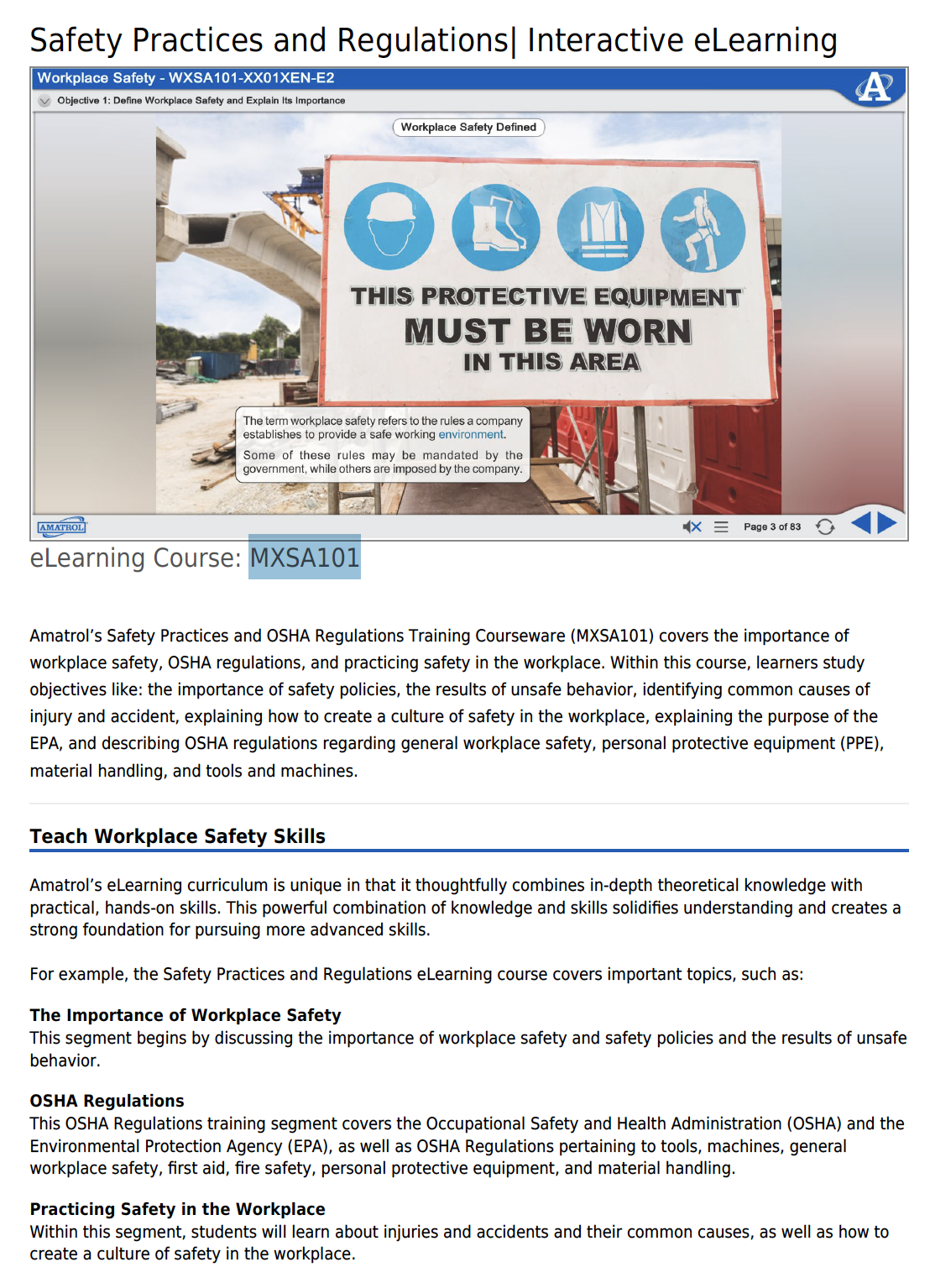
Amatrol’s Safety Practices and OSHA Regulations Training Course (MXSA101) focuses on workplace safety, OSHA regulations, and fostering a safety-conscious environment. Learners engage with topics such as understanding safety policies, recognizing the consequences of unsafe behaviors, identifying common causes of accidents, establishing a safety-oriented culture at work, comprehending the Environmental Protection Agency's (EPA) purpose, and detailing OSHA regulations concerning general workplace safety, personal protective equipment (PPE), material handling, as well as tools and machinery.
Learning Topics
- The Importance of Workplace Safety
- OSHA Regulations
- First Aid and Fire Safety
- Personal Protective Equipment
- Environmental Protection Agency
- Practicing Safety in the Workplace
- Common Causes of Workplace Injury
- Common Causes of Workplace Accidents
- Creating a Culture of Safety
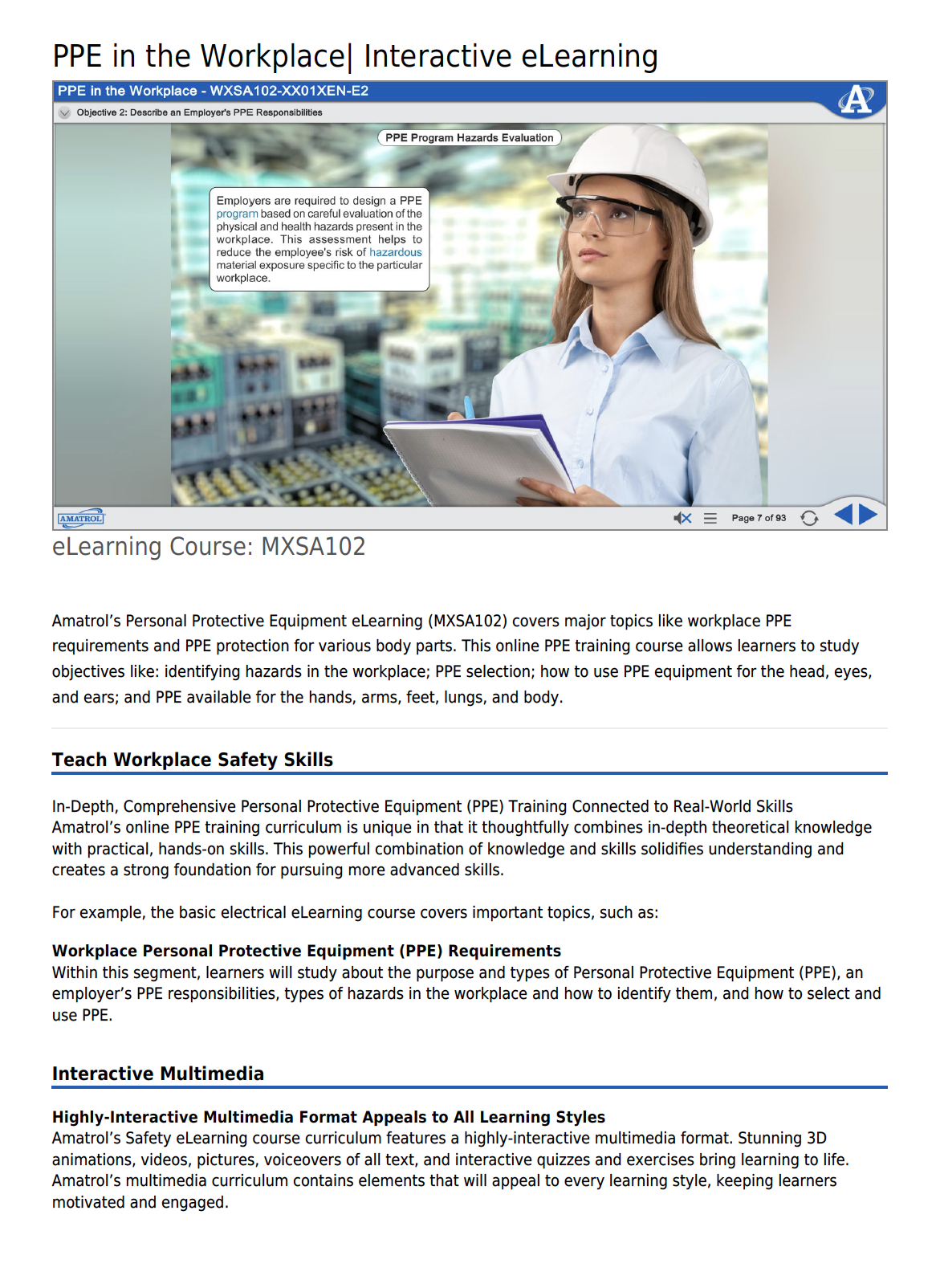
Amatrol’s MXSA102 eLearning program on Personal Protective Equipment (PPE) delves into critical aspects such as workplace PPE prerequisites and safeguarding various body parts. This online training equips learners to grasp essential objectives, including hazard identification, PPE selection, and the application of protective gear for the head, eyes, ears, hands, arms, feet, lungs, and body.
Teaching Workplace Safety Proficiencies
Amatrol’s comprehensive PPE training course bridges theoretical knowledge and practical skills. It uniquely combines in-depth understanding with hands-on experience, forming a robust foundation for advancing skill sets.
For instance, the foundational electrical eLearning module covers crucial topics such as Workplace PPE Requirements. In this section, participants delve into the purpose and varieties of PPE, employer responsibilities, hazard identification in workplaces, as well as PPE selection and utilization.
Engaging Multimedia
Amatrol’s Safety eLearning curriculum employs a highly interactive multimedia format to cater to diverse learning preferences. Featuring immersive 3D animations, videos, imagery, voiceovers, and interactive quizzes, this approach brings the learning experience to vivid life.
Learning Topics
- Workplace PPE Requirements
- Types of Personal Protective Equipment
- Identifying Workplace Hazards
- PPE Selection
- Using Head Protection PPE
- Using Eye Protection PPE
- Using Ear Protection PPE
- PPE for the Hands and Arms
- PPE for the Feet
- PPE for the Lungs
- PPE for the Body
Amatrol’s Hazardous Communication (HAZCOM) Multimedia Course (MXSA103) comprehensively explores topics including hazardous material definitions, standards, and their applications within hazardous communication documents. This online training equips learners to grasp objectives covering chemical hazards, biological hazards, chemical and physical health risks, hazard communication standards, levels of HAZCOM responsibility, safety data sheets, and chemical container labeling systems.
Facilitating Workplace Safety Mastery
Amatrol’s eLearning curriculum stands out by seamlessly integrating profound theoretical knowledge with hands-on practical skills. This symbiotic approach fortifies comprehension, laying a sturdy groundwork for advancing skill sets.
For instance, in the basic electrical eLearning module, key topics encompass understanding hazardous materials: definitions, utilization, and criteria. This section offers insights into hazardous material types, exemplifying chemical and biological hazards, chemical and physical health risks, hazard communication standards, and diverse levels of HAZCOM responsibilities.
Decoding Hazardous Communication Documents
This segment delves into the significance and utility of Safety Data Sheets (SDS), the cruciality of chemical container labeling, and the systems used for hazardous chemical labeling.
Interactive Multimedia Engagement
Highly Interactive Multimedia Format Catering to Varied Learning Preferences
Amatrol’s Safety eLearning curriculum employs a highly engaging multimedia format. Featuring captivating 3D animations, videos, image galleries, text-to-voice narration, and interactive quizzes, this format enlivens the learning experience.
By appealing to diverse learning styles, Amatrol’s multimedia curriculum ensures sustained engagement, motivating learners and enhancing their educational journey.
Learning Topics
- Workplace PPE Requirements
- Hazardous Materials Uses
- Hazardous Materials Standards
- Chemical Hazard Examples
- Biological Hazard Examples
- Chemical Health-Related and Physical Hazards
- HAZCOM Responsibility Levels
- Safety Data Sheets
- Chemical Container Labeling
- Chemical Labeling Systems
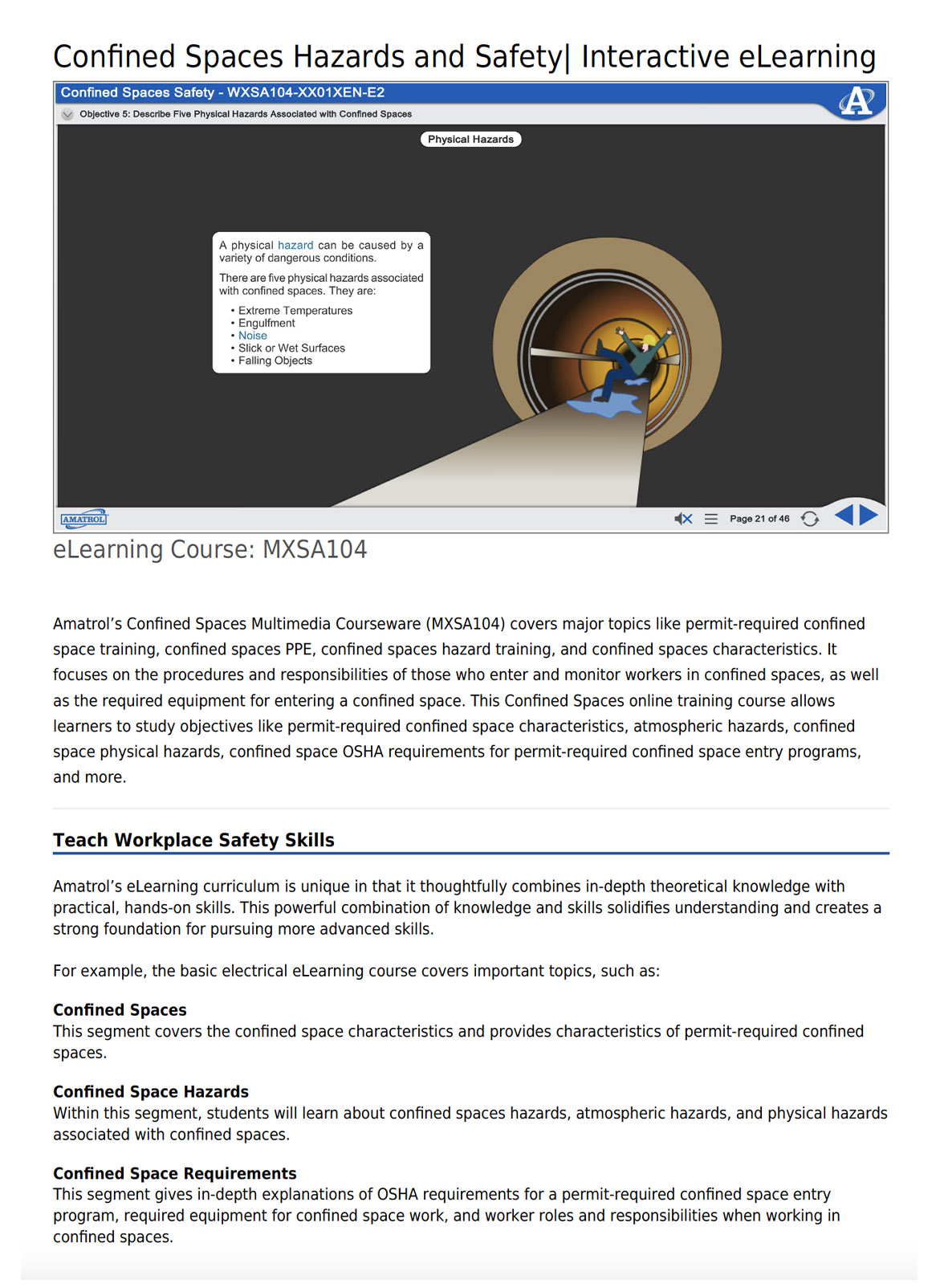
Amatrol’s Confined Spaces Multimedia Courseware (MXSA104) delves into critical subjects including permit-required confined space training, confined spaces PPE, hazard training, and their characteristics. It emphasizes the protocols and obligations for individuals entering and overseeing workers in such spaces, along with the necessary equipment. This online training equips learners to explore permit-required confined space characteristics, atmospheric and physical hazards, and OSHA requirements.
Key Learning Areas:
- Understanding Confined Space Characteristics
- Permit-Required Confined Spaces
- Identifying Confined Spaces Hazards
- Analyzing Confined Space Atmospheric and Physical Hazards
- Comprehending OSHA Requirements for Permit-Required Confined Space Entry Programs
- Proper Employment of Confined Spaces PPE
- Roles and Responsibilities of Confined Space Workers
Interactive Multimedia Experience
Immersive Learning for Practical Workplace Safety Skills | Comprehensive eLearning Curriculum
Amatrol’s eLearning curriculum uniquely amalgamates deep theoretical knowledge with hands-on practical skills, ensuring a robust foundation for advanced learning.Understanding Confined Spaces
Exploration of confined space characteristics and specifics of permit-required confined spaces.
Confined Space Hazards
Detailed insights into confined spaces hazards, encompassing atmospheric and physical dangers associated with such spaces.
Meeting Confined Space Requirements
In-depth understanding of OSHA stipulations for permit-required confined space entry programs, essential equipment for confined space work, and worker responsibilities while operating in such environments.
Comprehensive eLearning Curriculum
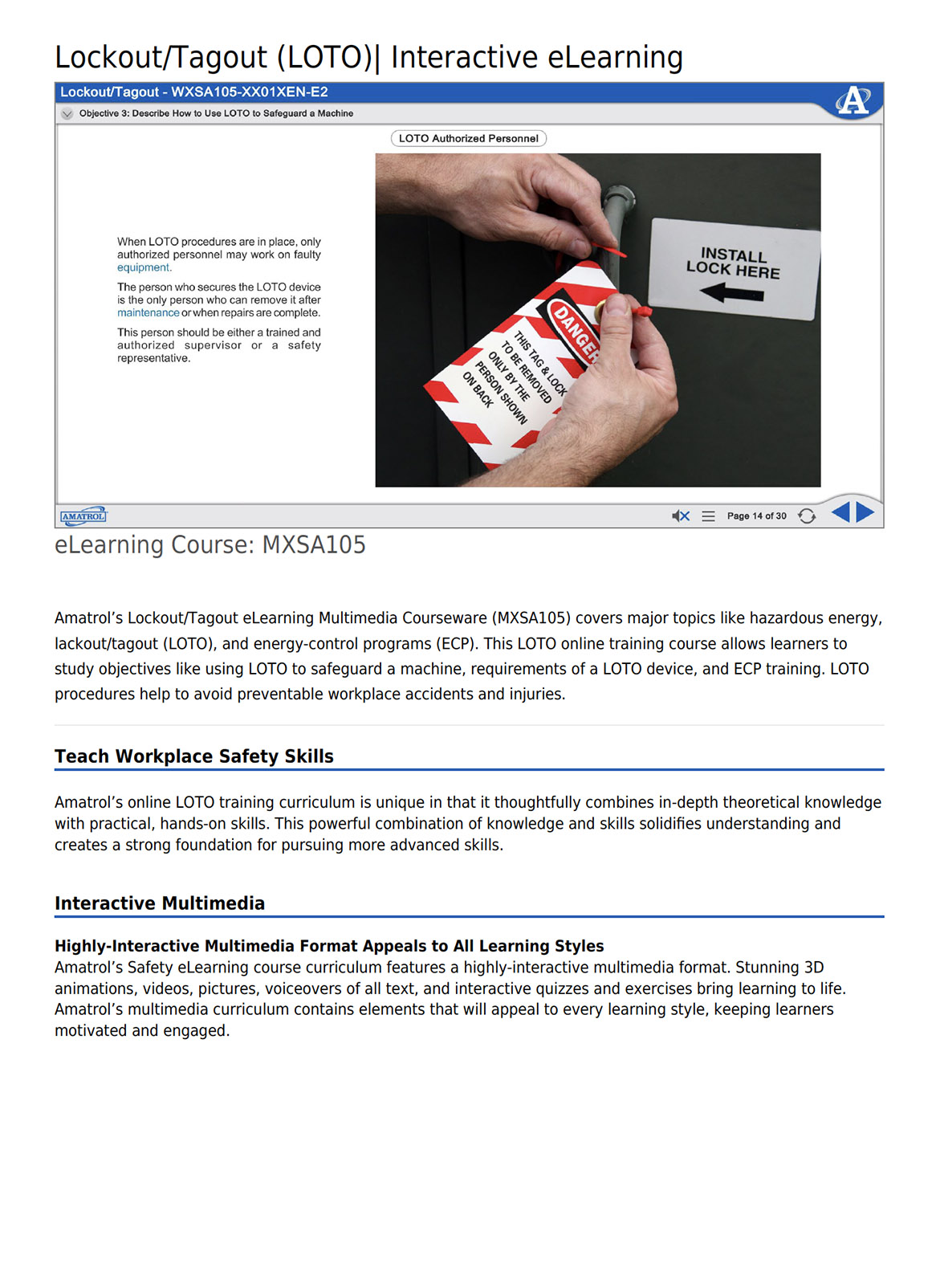
Amatrol’s Lockout/Tagout eLearning Multimedia Course (MXSA105) delves into crucial aspects such as hazardous energy, lockout/tagout (LOTO), and energy-control programs (ECP). This online training equips learners with the skills to utilize LOTO for machine safeguarding, comprehend LOTO device prerequisites, and undergo ECP training, crucial for preventing avoidable workplace accidents and injuries.
Key Learning Areas:
- Understanding Hazardous Energy
- Recognizing Hazards Associated with Energy
- Importance of Lockout/Tagout (LOTO)
- Implementing LOTO for Machine Safety
- Requirements for LOTO Devices
- Energy-Control Program (ECP)
Interactive Multimedia Experience
Integrating Essential Theoretical and Practical Workplace Safety Training
Amatrol’s online LOTO training curriculum uniquely combines profound theoretical knowledge with practical skills, establishing a robust foundation for mastering advanced safety procedures.
Comprehensive eLearning Curriculum
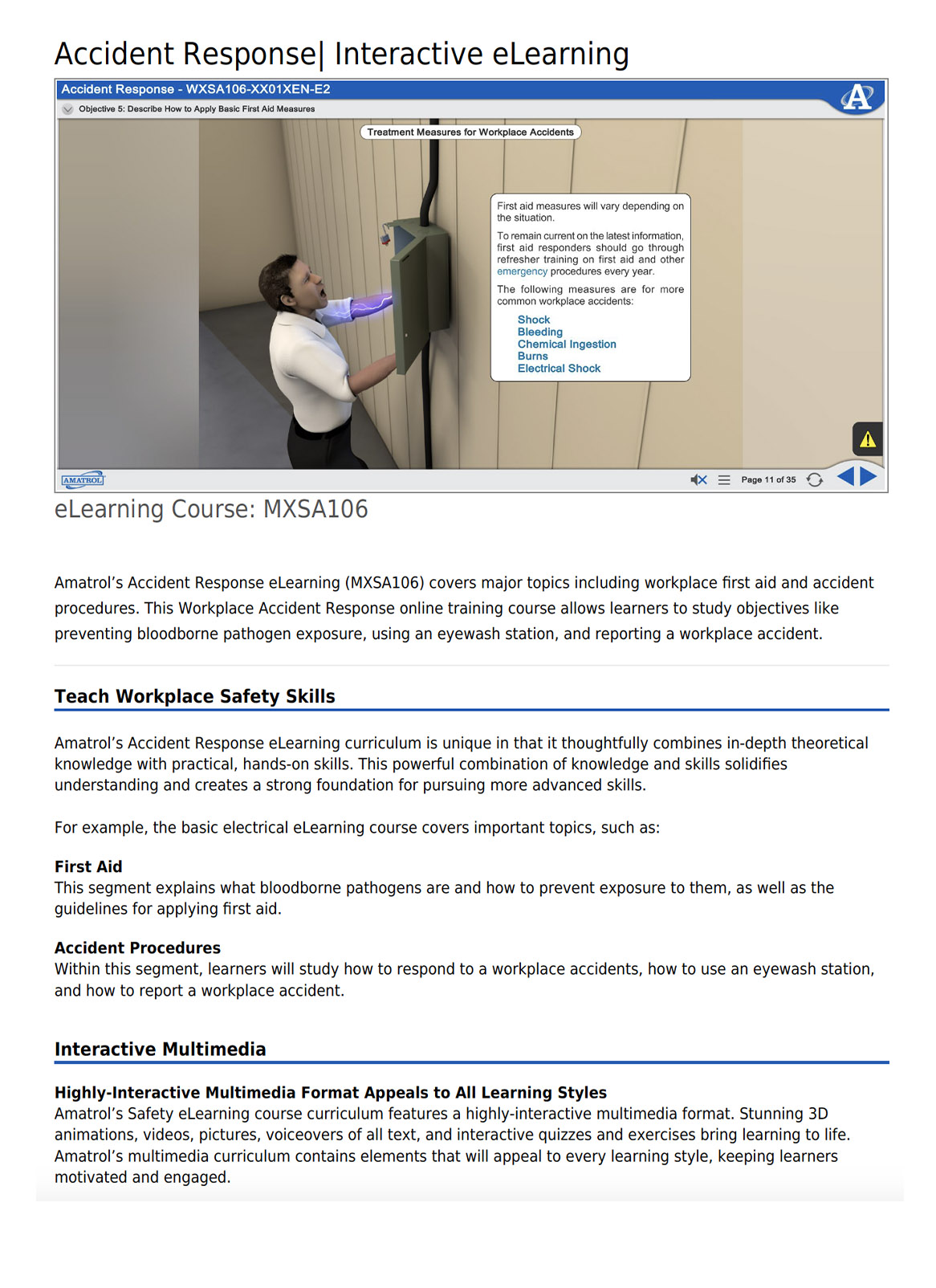
Amatrol’s Accident Response eLearning provides comprehensive training on workplace first aid and accident protocols. This online curriculum enables learners to understand and prevent bloodborne pathogen exposure, use eyewash stations effectively, and effectively report workplace accidents.
Key Learning Areas:
- First Aid Guidelines and Applications
- Basic First Aid Measures
- Understanding Bloodborne Pathogens and Preventing Exposure
- Accident Procedures and Workplace Response
- Effective Eyewash Station Usage
- Workplace Accident Reporting
Interactive Multimedia Experience
Integrating Essential Theoretical and Practical Workplace Safety Training
Amatrol’s Accident Response eLearning curriculum uniquely merges comprehensive theoretical knowledge with hands-on practical skills, establishing a sturdy foundation for mastering essential safety procedures.
Pages
-
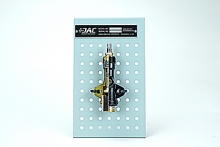 Item Number:373-195
 -
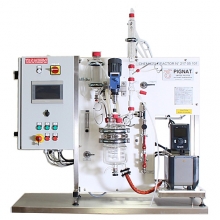 Item Number:REA/3000Pignat's Computerized Chemical Reactor (REA/3000) is a one-gallon, controlled, multi-purpose, jacketed glass reactor system specifically designed for education and research. This unit supports the study of controlled batch chemical reactions and allows students to operate and experience reaction processes and modify the variables upon which the reactions being studied are based.
 -
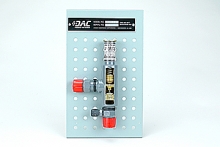 Item Number:373-519This Condenser Pressure Control Valve (KVR) Cutaway provides a full cutaway view of a control valve that exposes the complete internal components and operating principles.
 -
 The Confined Space Entry simulation is ideal for future employees or supervisors who work in or around work environments that utilize confined spaces. This course will equip learners with the knowledge and skills necessary to safely enter and work in confined spaces.
 -
 The Construction Electrical Hazard awareness simulation is ideal for future employees and supervisors who work in or around active construction sites. The primary goal of this course is to teach workers safe work procedures to follow while working around electrical hazards in a construction environment.
 -
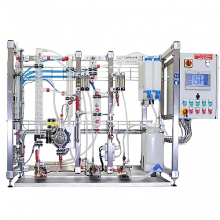 Item Number:DVI/100Pignat's compact, benchtop Continuous Distillation trainer (DVI/100) allows students to operate a continuous distillation process. Expertly crafted glass components show the flow of fluid through the complete process in both liquid and gaseous phases. With an efficient startup time, steady-state operation can be reached in 20 minutes.
 -
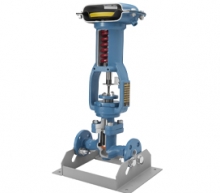 Item Number:255DAC Worldwide’s Control Valve Cutaway, .75"-1.5" (255) supports realistic classroom training in the operation, construction, and maintenance of a pneumatically-operated control valve used in industrial process systems. The complete internal configuration of the valve’s actuator and body is exposed and showcased through carefully-planned sectioning and color-coding.
 -
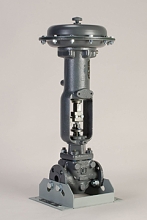 Item Number:255KDAC Worldwide's dissectible (255K) is a realistic, hands-on valve sample that supports realistic classroom training in the disassembly, inspection, and reassembly of a full-size industrial diaphragm-actuated control valve.
 -
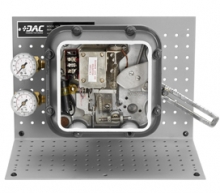 Item Number:273-810DAC Worldwide’s Control Valve Positioner Cutaway (273-810) is a detailed, sectioned, professionally-crafted control valve positioner cutaway that depicts a common control valve positioner.
 -
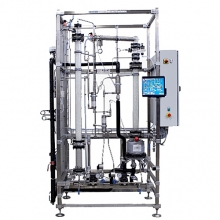 Item Number:ABR/3000The regeneration process is observed on the second column, which is continuously fed. An energy‐saving heat exchanger is placed between the two columns to optimize energy usage. With this unit, students are able to study various control loops, determine mass balance, and process efficiency. The unit also includes a LabView monitoring system.