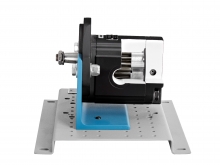
DAC Worldwide’s Hydraulic Gear Pump Cutaway, External-Type (778-110) is an industrial hydraulic gear pump that has been sectioned to reveal the inner workings of this component. This exposure allows learners to understand the design, operation, construction, and maintenance of this common process pump used throughout the industry.
Producing Lightweight, Durable Robot Parts on Stratasys Origin One
Ghost Robotics™ produces four-legged autonomous unmanned robots with all-terrain stability that can operate in almost any environment. These quadruped robots are size-scalable, ultra-agile, high-endurance, and easy to program. Simple mechanical systems increase the robots’ durability, agility, and endurance. The robots’ modular design supports the efficient field swapping of any sub-assembly.
Challenge
Ghost Robotics needed to produce lightweight, durable parts, with a cosmetic surface finish, for its Spirit™ Series robot.
- The team needed to stay agile, shipping units to customers while maintaining the ability to iterate designs based on customers’ feedback.
- Injection molded parts and CNC machined parts were cost-prohibitive, had long lead times, and could not be easily iterated on.
- The company considered other 3D printing methods as a solution, but the parts weren’t isotropic the mechanical properties weren’t strong enough; and the surface quality was too rough for the parts to be given to customers.
Ongoing sustainment for aging aircraft components
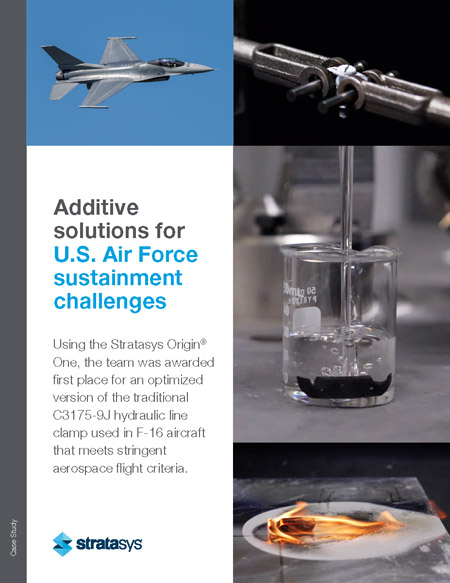
The U.S. Air Force increasingly faces sustainment challenges, including cost, speed, and supply chain agility, when using traditional manufacturing methods to maintain aging aircraft components. The department often seeks innovative engineering solutions to keep aircraft aloft and to modernize the fleet. In 2020, they hosted an open competition to quickly find new and creative 3D printing solutions for the C3175 family of hydraulic line clamps. Thousands of these clamps are used in the Air Force’s F-16 aircraft, in areas like landing gear cavities, and they frequently fail after extended exposure to vibration, environmental chemicals, and heat cycling. Historically, these clamps have been injection molded or CNC machined from a phenolic material that off-gases toxic formaldehyde.
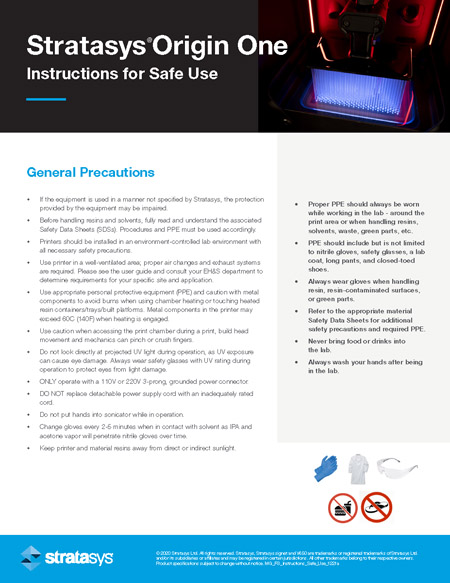
The Origin One printer is designed to be a safe and reliable rapid prototyping printer. Access to areas of the printer is potentially dangerous. Download the Stratasys Origin One Instruction for Safe Use.
InterPRO Helps Distek Serve More Customers with 3D Printed Adapters
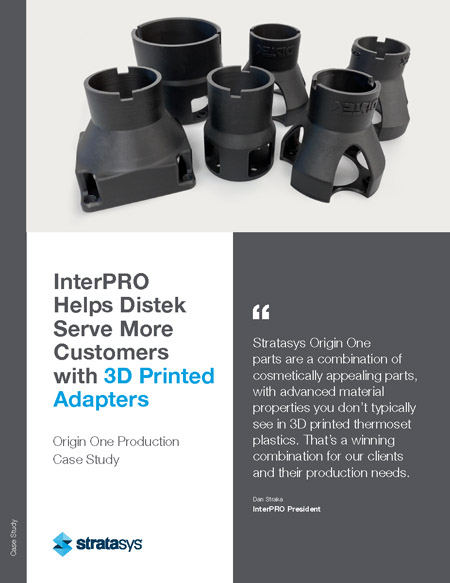
InterPRO Additive Manufacturing Group, a service bureau, started as a 3D printing prototyping company and is seeing growth in production applications due to advancements in 3D print technology and materials. InterPRO’s client Distek, a leading manufacturer of laboratory testing instruments for the pharmaceutical and biotechnology industries, asked InterPRO to help them manufacture a motor adapter that would allow prospective customers to use Distek’s technology with customers’ existing motors. InterPRO used Stratasys’ Origin® One’s next-generation 3D printing hardware and software to print parts compatible with Distek’s bioreactor and their client’s devices. The parts had injection molded-like strength, consistency, and durability. The surface finish had an impressive, consumer-grade look and feel.
Distek’s challenge was to produce a motor adapter compatible with their proprietary bioreactor and their clients’ motors. However, the adapter design wasn’t easily manufacturable by CNC machining, injection molding, or even cast urethane. In addition, the company needed a fast turnaround to meet immediate customer needs for various adapter sizes in low volumes. High up-front tooling costs, long lead times, and low-volume demand ruled out traditional methods. As a result, InterPRO turned to 3D printing as a possible solution.
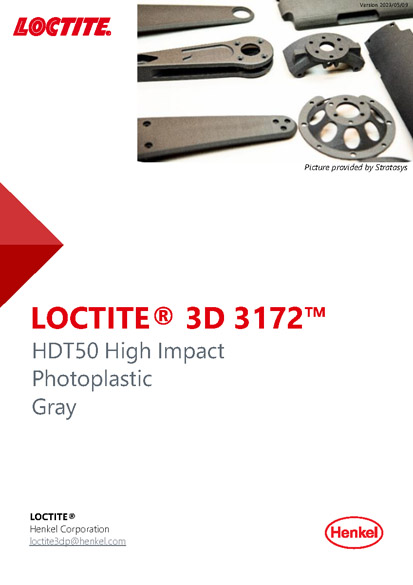
LOCTITE 3D 3172 is a durable photopolymer resin that enables functional parts production where high stiffness with a good surface finish and high impact resistance are required. Parts manufactured with this resin can be machined, tapped or polished.
LOCTITE 3D 3172 is compatible with various DLP machines.
Benefits:
- Tough & durable
- Superior impact strength
- Nice surface finish, machine-able
Ideal for:
- Manufacturing aids / Jigs & Fixtures
- Housings
- Insoles
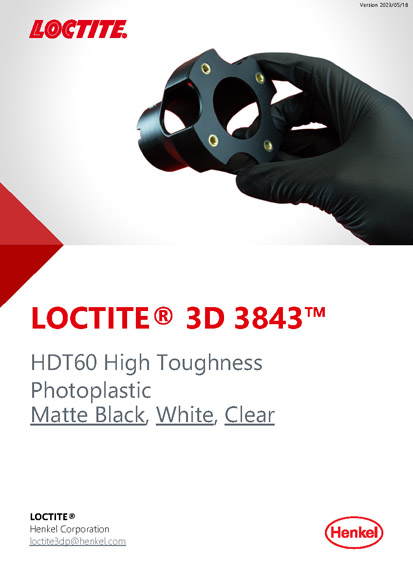
HDT60 High Toughness Photoplastic
Matte Black, White, Clear
LOCTITE 3D 3843 is a semi-flexible resin with moderate temperature resistance HDT60, high impact strength, and versatility for various applications.
LOCTITE 3D 3843 is a high-strength engineering plastic with good impact resistance and surface finish. It is ideal for many different tooling applications on the production floor.
LOCTITE 3D 3843 displays high green strength and HDT enabling it to print accurately and function at room temperature. It is compatible with a broad range of DLP machines.
Benefits:
Ideal for:
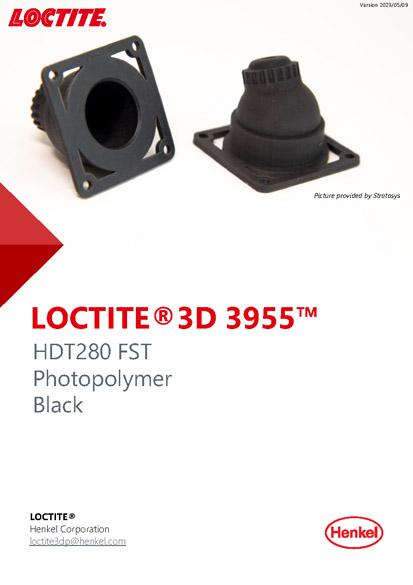
HDT280 FST Photopolymer
Black
LOCTITE 3D 3955 is a halogen-free, high-performance, high-modulus material with excellent flexural and tensile physical properties.
LOCTITE 3D 3955 passes UL94 V-0 flammability requirements, and FST (AITM2-0002, AITM2-0007, AITM3-0005) and its high HDT allows it to withstand harsh environments with negligible deformation.
Parts printed with LOCTITE 3D 3955 showcase an excellent surface finish making it ideal for connector and interior parts for aerospace and rail.
Benefits:
- Fire Safety Material
- Halogen Free
- Excellent flexural and tensile physical properties
Ideal for:
- HVAC Components for Aircraft
- Clips and Plugs for Control Systems/Cabinets
- Connectors, Electronic Housings
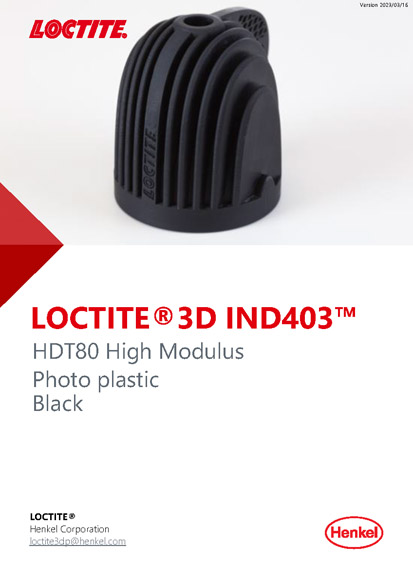
HDT80 High Modulus Photo plastic
Black
LOCTITE 3D IND403 is a high-temperature resistance material that allows the production of parts with high surface quality and outstanding dimensional accuracy. It is ideal for tooling production for processes such as silicone casting, low-pressure molding, and open-mold PU molding. The material can withstand mechanical stresses while maintaining dimensional stability for multiple cycles for fast product development and rapid process iteration.
Benefits:
- High heat deflection temperature, HDT 80oC
- Tough with good dimensional stability
- Good surface finish
Ideal for:
- Tooling and molds
- Interior applications in automotive
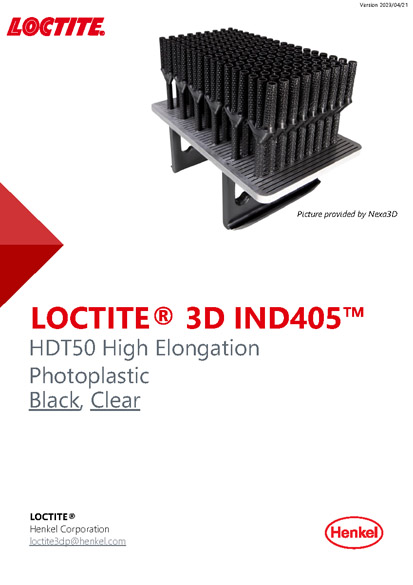
HDT50 High Elongation Photoplastic
Black, Clear
LOCTITE 3D IND405 is a rigid, high-strength, high-elongation engineering material with outstanding impact resistance and excellent surface finish properties. This stiff and durable high-performance material is ideal for various tools on the production floor, including manufacturing aids and final parts such as housings and consumer goods applications. Parts can be printed with various DLP printers and machined, tapped, or polished for the final finish.
Benefits:
- High impact resistance with high elongation
- Easy to print (one-part material)
- Tough and Durable
- The toughest clear resin (only applicable for clear material)
- Functional Prototyping
Ideal for:
- Clear prototypes (clear version)
- Fluid routing & consumer goods prototypes
- Manufacturing aids/tools
- Housings
HDT40 High Impact
Ultra Clear, White
LOCTITE 3D MED412 is a durable material with excellent elongation, impact strength, and surface finish. It has been designed to enable the manufacture of medical devices and their component parts that require good stiffness and wear resistance. It is capable of meeting ISO 10993-5and-10 standards for biocompatibility when processed using a validated workflow. Certificates of compliance are available upon request.
Benefits:
- Capable of meeting ISO 10993-5 & -10 standards for biocompatibility
- Tough with Superb Elongation
- Good Impact Strength and Surface Finish
Ideal for:
- Class I and II Medical Devices
- Medical Equipment Components
Pages
-
 Item Number:778-110
 -
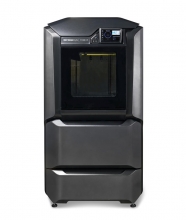 Item Number:F190CR and F370CRIt starts with high-strength composite materials, but the Stratasys composite-ready F Series offers much more. More materials, more reliability – more capability than other similar printers.
 -
 The Fall Protection awareness simulation is ideal for future employees and supervisors who will work in or around construction environments. The primary goal of this course is to teach workers safe procedures when working at heights on a construction site.
 -
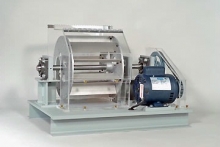 Item Number:202-000DAC Worldwide’s Fan Balancing Trainer (202-000) is a precision assembly allowing for convenient demonstration and training in fan balancing and other vibration analysis-related topics. Based on the design of a typical squirrel cage fan, this heavy-duty aluminum device allows for assembly in a variety of configurations, creating a broad range of balancing scenarios.
 -
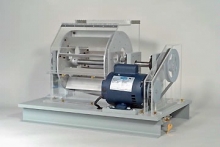 Item Number:202-PACDAC Worldwide’s Fan Balancing Training System Plus (202-PAC) is a hands-on industrial training system that allows learners to gain experience with fan balancing to achieve maximum fan efficiency and stability.
 -
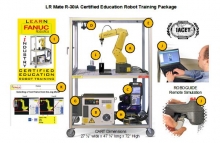 A large working envelope with a reach of 717 mm, and a payload of 7 kg, combine to provide solutions for high productivity handling and assembly applications.
 -
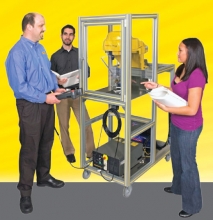 With FANUC Robotics’ CERT Program, new courses and project based activities prepare students for a workplace that will be increasing in robotic automation. The Fanuc Robotics Education Training Cart incorporates the compact M-1+A robot housed in a self contained, mobile enclosure. The lightweight parallel-link M-1+A robot is designed for small part handling, high speed picking and assembly applications.
 -
 FANUC America now offers Certified Education Robot Training (CERT) to qualifying High Schools, Community Colleges, and Universities. With FANUC America's educational robots, students can learn to utilize the latest automation technology while applying Science, Technology, Engineering, and Math. Industrial robotics training in the classroom can safely be achieved through the CERT program. FANUC America provides the necessary training to the instructor as well as a curriculum to introduce students to robot applications.
 -
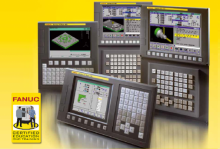 The FANUC CNC Certified Education Training program is an industry certification available to qualified high schools, community colleges, and universities. The program certifies instructors at educational institutions to train their students to program, set-up and operate CNC machine tools using FANUC’s control platform.
 -
 Item Number:D73F-0320-PB00Experience the cutting-edge in CNC machining simulation with FANUC's D73F-0320-PB00 simulator. Equipped with real kinematics, live machine movement, and advanced features like collision detection, immerse yourself in a true-to-life machining experience. Discover the power of virtual milling or lathe operations with our software-only version for seamless integration. Get ready to revolutionize your CNC training!