A full cutaway view of the valve body exposes the complete internal design characteristics, flow path, valve stem, compressor connection, backseat, front-seat, packing and gauge port, while retaining its operational characteristics.
Discover the ultimate solution for hands-on learning with the FANUC 0i-MODEL F Plus Simulator. Designed specifically for educational purposes, this cutting-edge tool revolutionizes the way students engage with CNC technology. Compact, portable, and seamlessly integrated into any classroom, it empowers educators to inspire the engineers of tomorrow. Dive into limitless learning possibilities and prepare your students for success in advanced manufacturing. Explore the features and benefits of the FANUC 0i-MODEL F Plus Simulator below and revolutionize your teaching approach today!
As pioneers in tactical medical equipment and training, TacMed Solutions is dedicated to providing cutting-edge medical solutions for military, law enforcement, and civilian responders worldwide. With a relentless commitment to quality and reliability, TacMed empowers individuals and organizations to respond effectively to life-threatening situations. Join us as we explore the forefront of medical innovation and discover how TacMed Solutions is revolutionizing tactical medical care.
Master CNC Techniques with Cutting-Edge Simulation
Experience the ultimate in CNC machining simulation with FANUC's innovative simulator. This advanced system includes all the features of our standard simulator, enhanced by an internal PC. Delve into a virtual world of milling or lathe operations with authentic kinematics, granting users a firsthand view of machine movement, tooling, and part machining. From setup to execution, enjoy a lifelike experience with the colored back plot, collision detection, and sound effects. For seamless integration, opt for our software-only version, enabling self-installation and connection via ethernet to our standard CNC simulator.
Features
- NC: Oi-F 3-axis Mill or 2-axis Lathe, switchable at reboot
- IPC: Pentium Processor N4200 1.1Ghz Quad core, 8GB RAM, 32GB SSD
- Ports: 4 USB 3.0
- HDMI display
- Software included: Windows 10, Machining Simulation, FASBacCNC
- Brackets
- User supplies: Monitor, keyboard & mouse
Mastering CNC with FANUC
Why Educational Programs Choose FANUC Simulators
Discover why educational institutions worldwide use FANUC CNC training simulators for immersive learning experiences in computer numerical control (CNC) machining. FANUC simulators provide students with a safe environment to master CNC programming, operation, and troubleshooting, all without the risk of damaging expensive machinery. FANUC's simulators provide realistic virtual machining experiences and intuitive interfaces to learners of all levels. By integrating FANUC CNC training simulators into their programs, institutions ensure students are equipped with the practical skills needed to thrive in the manufacturing industry's ever-evolving landscape.
Discover the backbone of fluid transfer in industries globally with centrifugal pumps, efficiently propelling fluids with precision and power.
Experience hands-on learning like never before with Amatrol’s 950-PM1. Dive into the mechanics of centrifugal pumps and their diverse applications, from high-flow, low-pressure scenarios to managing an array of fluids, including water, chemicals, and food-grade substances.
Our robust and top-tier system empowers learners to master the installation, operation, and maintenance of centrifugal pumps. Delve into crucial topics such as pump sizing, mechanical seal installation, and effective troubleshooting, all while gaining invaluable experience with authentic industrial equipment.
Unveil the potential of this learning system as it expands to encompass a multitude of pump types and operations, from series and parallel setups to turbine, diaphragm, and magnetic pumps.
Ready to elevate your understanding of centrifugal pumps? Explore the Centrifugal Pump Learning System and its expansion options.
Discover the cornerstone of workplace safety with Amatrol and DAC Training Solutions. DAC's comprehensive lock-out/tag-out training equips workers with crucial skills for controlling hazardous energy, ensuring a secure work environment across industries worldwide.
Join Mark Goodman, Director of North American Industry Sales at Amatrol, as he presents DAC Worldwide’s cutting-edge Lock-Out/Tag-Out Training System (811-000). Gain insight into its operation and key features while witnessing firsthand demonstrations of essential lock-out/tag-out techniques for electrical and fluid power systems.
TacMed Solutions' comprehensive Human & K9 Airway Intubation simulators equip participants with the knowledge and skills to perform airway intubation procedures effectively and confidently in both human and K9 patients. With TacMed Solutions, learners receive expert instruction and hands-on experience to enhance your lifesaving capabilities.
Overview
TacMed's Human & K9 Airway Intubation Training simulators are tailored to meet medical personnel and K9 handlers' unique needs. Through a combination of theoretical learning and practical exercises, participants will learn:
- Anatomy and physiology of the human and K9 airway
- Indications and contraindications for airway intubation
- Equipment selection and preparation
- Techniques for successful intubation in diverse scenarios
- Management of complications and troubleshooting
- Best practices for patient care and safety
Who can Benefit?
- Paramedics and EMTs
- Emergency physicians
- Nurses and nurse practitioners
- Tactical medics and law enforcement officers
- Military personnel
- Search and rescue teams
- K9 handlers and veterinary professionals
Contact Us
For inquiries or to book a demo for your team, contact us today. We're dedicated to empowering healthcare providers and first responders with the necessary knowledge and skills to save lives in critical situations.
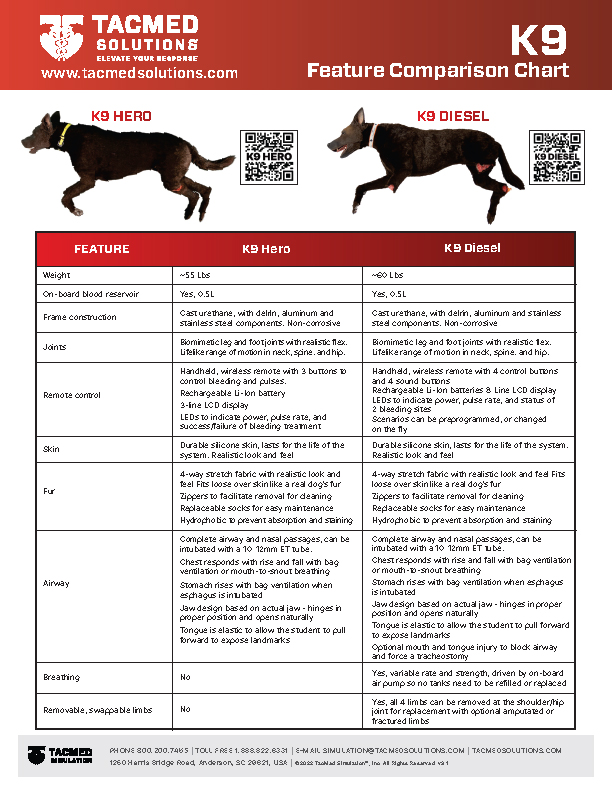
Having the right tools can make all the difference between life and death. TacMed, a leading medical simulator provider, offers two distinct models tailored to meet the diverse needs of emergency responder or veterinary training: the K9 Diesel and Hero. While both models are crafted with the same commitment to durability, functionality, and effectiveness, they serve unique purposes and cater to different training programs. This comprehensive feature comparison highlights each model's key features, capabilities, and target users.
K9 Diesel
TFX-K9-DSL-1
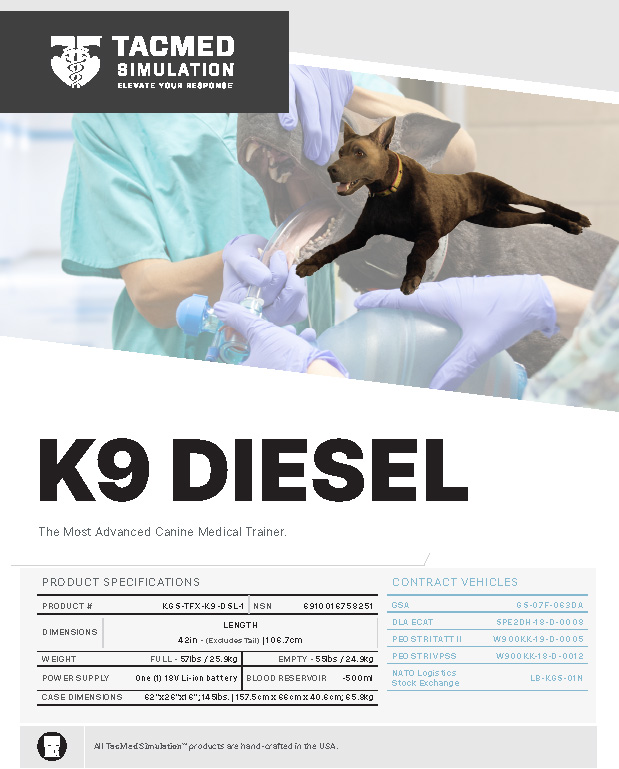
The Advanced Canine Medical Trainer (K9 DIESEL) is a full-body simulator for Operational Canine First Responders, Military Working Dog (MWD) handlers, Veterinarians, and Veterinary Technicians. Designed in partnership with the Department of Defense (DoD), K9 Diesel is a state-of-the-art skills trainer with active breathing, audio queues, and over 28 different features and medical intervention sites.
All training sites are designed to replicate actual medical procedures' look, feel, and function. Interchangeable limbs and injuries provide greater flexibility to vary wound patterns.
Key Features
- Realistic Airway & Breathing
- Intubation & Tracheostomy
- Simulated Tension Pneumothorax
- NCD, GDV w/ Air Release
- CPR
- Bleeding & Occlusion Feedback
- Bilateral Femoral Pulses
- Interchangeable Limb Options
- Packable Junctional Wounds
- Abdominal Evisceration
- IV Training (Bilateral) w/ Flash
- Bilateral Tibial and Humeral IO
- Real-Time Feedback on Remote
- Optional: Mouth Wound & Burn Sleeve
K9 HERO
TFX-K9-HERO-1
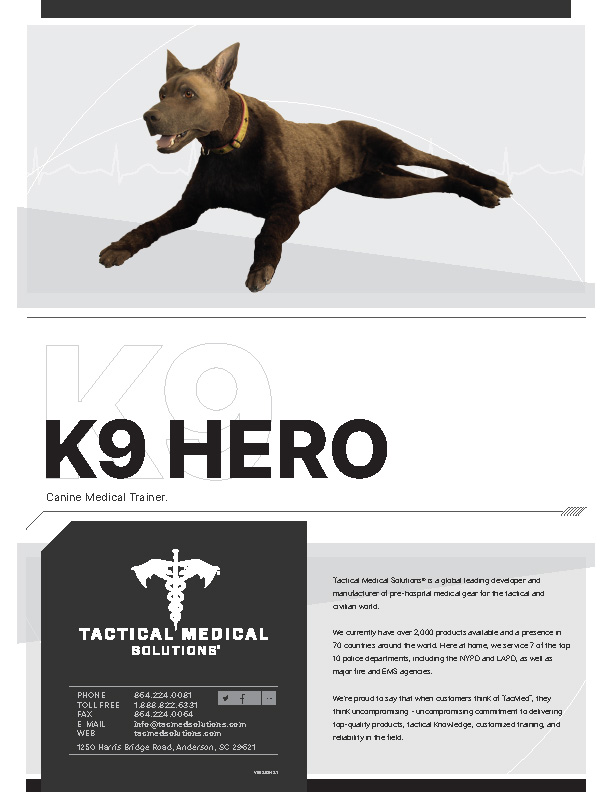
K9 Hero allows learners to perform critical life-saving tasks such as maintaining an airway, needle decompression/thoracocentesis, hemostasis, IV insertion, Intraosseous (I/O) infusion, Cardiopulmonary Resuscitation (CPR), tracheostomy, and bandaging.
Key Features
- Realistic Airway (NPA, OPA)
- Intubation & Tracheostomy
- Packable Wound
- Needle Decompression
- IV Training w/ Flash
- Bilateral Femoral Pulses
- Movable Jaw
- Remote Controlled
- Real-Time Feedback on Remote
- Realistic Skeletal Motion
- Optional: Mouth Wound & Burn Sleeve
The TacMed Simulation™ Advanced Canine Medical Trainer (K9 Diesel) is a full-body simulator for Operational Canine First Responders, Military Working Dog (MWD) handlers, Veterinarians, and Veterinary Technicians. Designed in partnership with the Department of Defense (DOD), K9 Diesel is a state-of-the-art skills trainer with active breathing, audio queues, and over 28 different features and medical intervention sites. All training sites are designed to replicate actual medical procedures' look, feel, and function. Interchangeable limbs and injuries provide greater flexibility to vary wound patterns. K9 Diesel is the most advanced K9 simulator available and allows learners to perform a wide range of critical life-saving tasks with an incredibly realistic experience.
The TraumaFX® Canine Medical Trainer (K9 HERO) is a full-body medical trainer for Operational Canine First Responders, Military Working Dog (WMD) handlers, Veterinarians, and veterinary technicians. All training sites are realistic to replicate actual medical procedures' look, feel, and function. The head of the simulator has been hand-sculpted to mimic a Belgian Malinois, and the exterior is covered in durable, non-staining synthetic fur. K9 HERO allows learners to perform critical life-saving tasks such as maintaining an airway, needle decompression/thoracocentesis, hemostasis, IV insertion, Intraosseous (I/O) infusion, Cardiopulmonary Resuscitation (CPR), tracheostomy, and bandaging.
Pages
-
 Item Number:373-195
 -
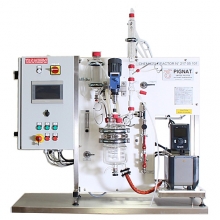 Item Number:REA/3000Pignat's Computerized Chemical Reactor (REA/3000) is a one-gallon, controlled, multi-purpose, jacketed glass reactor system specifically designed for education and research. This unit supports the study of controlled batch chemical reactions and allows students to operate and experience reaction processes and modify the variables upon which the reactions being studied are based.
 -
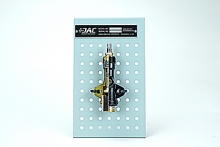
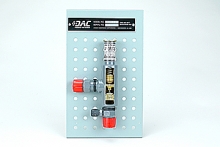 Item Number:373-519This Condenser Pressure Control Valve (KVR) Cutaway provides a full cutaway view of a control valve that exposes the complete internal components and operating principles.
 -
 The Confined Space Entry simulation is ideal for future employees or supervisors who work in or around work environments that utilize confined spaces. This course will equip learners with the knowledge and skills necessary to safely enter and work in confined spaces.
 -
 The Construction Electrical Hazard awareness simulation is ideal for future employees and supervisors who work in or around active construction sites. The primary goal of this course is to teach workers safe work procedures to follow while working around electrical hazards in a construction environment.
 -
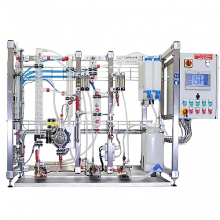 Item Number:DVI/100Pignat's compact, benchtop Continuous Distillation trainer (DVI/100) allows students to operate a continuous distillation process. Expertly crafted glass components show the flow of fluid through the complete process in both liquid and gaseous phases. With an efficient startup time, steady-state operation can be reached in 20 minutes.
 -
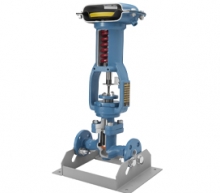 Item Number:255DAC Worldwide’s Control Valve Cutaway, .75"-1.5" (255) supports realistic classroom training in the operation, construction, and maintenance of a pneumatically-operated control valve used in industrial process systems. The complete internal configuration of the valve’s actuator and body is exposed and showcased through carefully-planned sectioning and color-coding.
 -
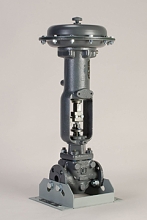 Item Number:255KDAC Worldwide's dissectible (255K) is a realistic, hands-on valve sample that supports realistic classroom training in the disassembly, inspection, and reassembly of a full-size industrial diaphragm-actuated control valve.
 -
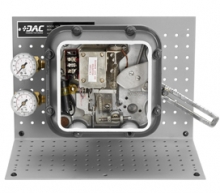 Item Number:273-810DAC Worldwide’s Control Valve Positioner Cutaway (273-810) is a detailed, sectioned, professionally-crafted control valve positioner cutaway that depicts a common control valve positioner.
 -
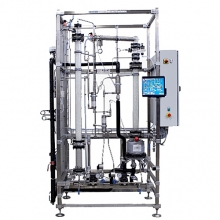 Item Number:ABR/3000The regeneration process is observed on the second column, which is continuously fed. An energy‐saving heat exchanger is placed between the two columns to optimize energy usage. With this unit, students are able to study various control loops, determine mass balance, and process efficiency. The unit also includes a LabView monitoring system.